
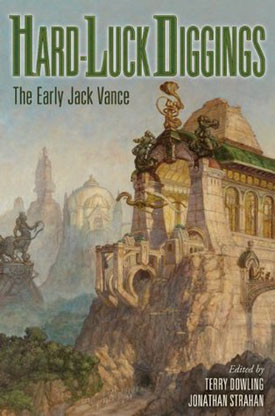
 Hard Luck Diggings collects fourteen of Jack Vance’s earliest published stories, originally appearing between 1948 and 1959. As editors Terry Dowling and Jonathan Strahan point out in their Introduction, what we see here is Vance not only mastering his craft, but finding his audience. As might be expected, these stories, while all capable, are not uniformly wonderful (although which are what is going to have a heavily subjective basis), nor are they all uniformly what we now think of as “Jack Vance stories,” although one can find here not only the beginnings of Vance’s distinctive voice, but some full-blown examples of what that voice would become.
The title story makes use of a trope that periodically enjoys some popularity — the alien intelligence that goes unrecognized until someone puts seemingly unrelated pieces together, in this case Magnus Ridolph, Vance’s own Holmes doppelganger. It’s not a particularly distinctive story, but entertaining enough. “The Temple of Han” gives us another familiar story line, a duel between a man and something much more than human — in this case, a god (or a reasonable facsimile thereof). If we fast-forward a bit, to “Abercrombie Station,” we start to see a more distinctively Vance story — this one a tale about a not-very-nice girl, when all is said and done, who has her eyes set on a couple million dollars and doesn’t much care what it takes to get it. Jean Parlier comes close to being the type specimen of the Vance hero: mentally and morally supple, quick on the uptake, and doggedly determined. The first story that I recognized as typical of the writer is “Shape-Up,” hinging on a mystery with an intricately constructed solution that turns out not to be the solution. In this one, the diction is pure Jack Vance, as are the characters, and it’s a treat.
“The Devil on Salvation Bluff” gives us another typically Vance situation, in which those who have come, in this case, to a planet with a “lost” fragment of humanity, determined to lift the natives up to nice, orderly, civilized lives, find themselves stymied: not only do the natives not cooperate, but neither does the planet.
When confronted by a collection such as this, early works of a writer whose career one has followed with enthusiasm, it’s a bit double-edged. In the broad canon of science fiction since World War II (these all date from the 1950s), they’re not particularly remarkable, although there’s certainly nothing here that Vance needs to be embarrassed about — for the time, they were at least a cut above average. They are certainly not the Jack Vance of the 1960s, when he produced such stellar works as “The Dragon Masters” and “The Moon Moth.” And perhaps this is in part, at least, Vance’s fault: he’s one of the voices of the Golden Age who pushed the genre along the path that brought it to where it is now. Take them as historical documents, but be careful: they’re likely to set you up for your own private Jack Vance retrospective.
(Subterranean Books, 2010)
