
What can I say about Connie Willis, except that she is one of the most consistently engaging writers I’ve ever run across? The Winds of Marble Arch and D.A. reinforce that opinion: they are, in a word, terrific.
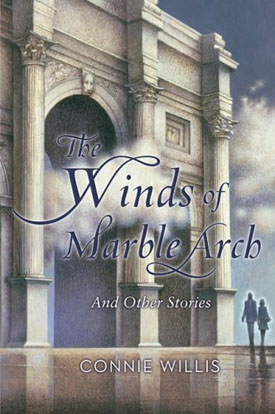 The Winds of Marble Arch begins with an introduction by Willis discussing her influences (including P. G. Wodehouse, which leads to astonishing fact number whatever: no, she is not British) that itself is worth the price of the book. As for the stories themselves, I’m only going to be to touch on a few, essentially picked at random, because they all pretty much rank as highlights. (If you don’t believe me, let me point out another astonishing fact: of the twenty-three works in this volume, thirteen have either won or been nominated for the Hugo, Nebula, or World Fantasy awards, sometimes two out of the three in various combinations.)
Willis has created groups under headings that bear an often indirect relationship to those stories included. “Weather Reports,” for example, includes the title story, about strange winds in the tube station at Marble Arch — and out-of-place odors and mysterious cries. It’s about much more than that, of course. “Blued Moon,” the second story, is a mordantly funny send-up of corporate speak against a background of possible contributions to global warming.
The section on “Travel Guides” includes “Fire Watch,” a story about academic study in a world that includes time travel, set in the same universe as Willis’ Blackout. “Epiphanies” contains what is, in a collection of exceptionally good stories, one that immediately became a favorite of mine, “At the Rialto.” It’s about scientific conventions, hotel clerks who are really actresses and fairly clueless at that, middle-aged scientists, romance, and quantum mechanics. It is biting, charming, and a bit loopy.
These stories — many of them novellas, actually — embrace a wide range in subject, tone and approach, from the surreality of “Daisy, In the Sun” thought the slightly offside take on the world “after the Apocalypse” in “A Letter From the Clearys” and the subliminal horror of “All My Darling Daughters” to the haunting “Jack” (another Blitz story). It goes without saying that they all have more dimensions than I can get I into here, so what I’m describing is seldom all that you get.
And then there are the common threads that mark them indelibly as stories by Connie Willis. Her protagonists are actually people who do things, people who are more or less in control of their lives (as much as anyone can be) and who use their brains and energy to take charge, unlike the hordes of feckless idiots who inhabit so much of contemporary science fiction and even more, contemporary fantasy. Willis is an edgy writer, a quality that shows up here in the twists on otherwise hackneyed plots and otherwise stereotyped characters. And these are stories with attitude, mostly reflected in the raucous satire with which Willis pillories our contemporary foibles. She is not, however, afraid to tackle “serious,” and does it with consummate skill. One of the most refreshing things about these stories is the frequency with which adults fall in love — in a sensible, eyes-open sort of way that still holds a strong measure of romance.
 D.A., a young adult novel — really another novelette — is almost a type specimen of the lighter side of Willis’ writing. Theodora Baumgarten, a high-school senior who plans to go to UCLA, instead wins appointment to the Space Academy — even though she didn’t apply and doesn’t want to go. It doesn’t matter — within a day she is in space on a training ship, trying to survive her first week as a cadet and find out what went wrong and fix it. Theodora is a typical Willis hero, smart, capable and determined, and her adventures provide a lot of room for an acidic look at bureaucracy, teenagers, and what can happen when you actually do think outside the box. It’s a classic Heinlein juvenile brought up to date in a funny and refreshing way.
If Connie Willis is not on your list of “must read” authors — well, you need to do something about that. The Winds of Marble Arch and Other Stories is a great way to start.
(Subterranean Press, 2007)
(Subterranean Press, 2007)
