
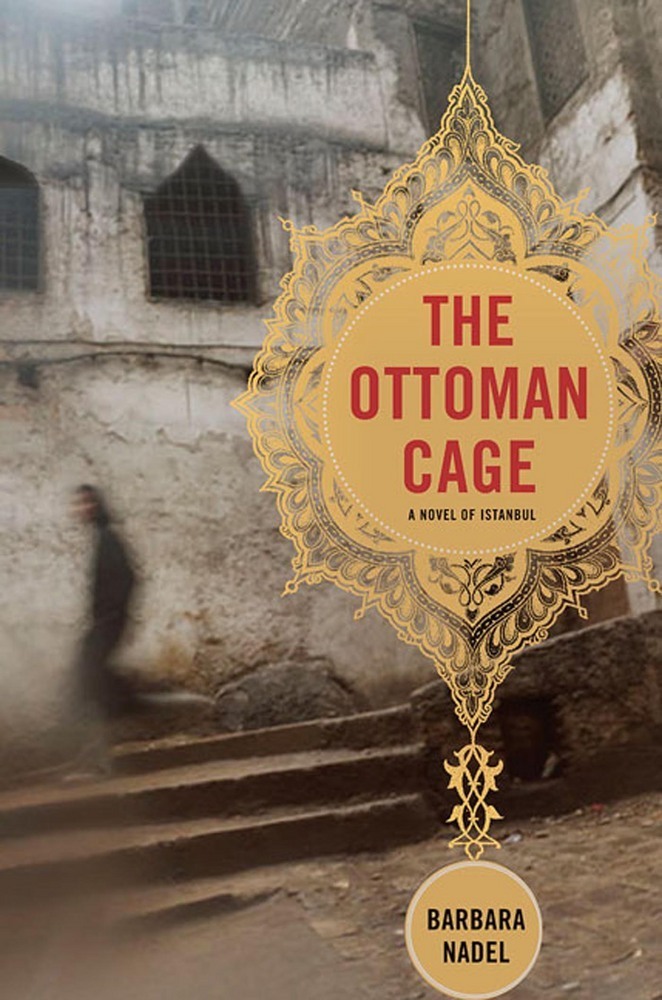
 We have an office at Green Man, staffed by brownies, of course, that does searches for books that might interest us. One of those searches netted me a copy of The Ottoman Cage. I’m easy for the brownies to figure out – they just look for fiction set in Turkey! When I looked at the book, I noticed a reference on the dust jacket to Belshazzar’s Daughter, an earlier volume in the same series, so I asked the brownies to find me a copy of that, too. So far, they haven’t succeeded. Pity!
This series is set in contemporary Istanbul, a most intriguing locale for murder mysteries. The book is not as rich in detail about the city itself as I would have liked. Nonetheless, Nadel gives quite a few clues to suggest that she has a good understanding of contemporary Turkish culture, which is still working through the transition into a Western, secular society over eighty years after the fall of the Ottoman Empire. For example, many of the characters smoke cigarettes, although smoking tobacco is forbidden under strict Muslim law. One character even makes a joke about cigarettes killing more Turks than the Christians ever did. Some of the characters are practicing Muslims, while others are Armenian Christians. A few characters come from old Ottoman families; they are still uncomfortable calling themselves Turks. A couple of minor characters say they are ‘from the hills’, which I construe to mean that they are Kurdish.
Inspector Çetin Ikmen is the primary of three main characters. He’s a middle-aged guy, short and small of frame. He describes himself as ugly. An inveterate chainsmoker, Inspector Ikmen also has a fondness for the bottle (also forbidden under Muslim law), loses track of time, and hates paperwork. He has a great deal of trouble using his mobile phone – sometimes even forgetting to carry it on his person. In all these traits, he is like countless other cops and private eyes who have wandered through the pages of crime fiction for decades. What makes him different, other than the fact that he’s Turkish (rather half Turkish – his mother was Albanian), is that he supports a wife, nine children, and an elderly father on his somewhat meager salary. The wife, the father and some of the children appear as secondary characters, but we don’t have much opportunity to observe Ikmen interacting with them except by phone. At least in this novel, he didn’t spend much time with them.
The second main character is Dr. Arto Sarkissian, a forensic pathologist who has been Ikmen’s best friend since childhood. As his name suggests, Arto is an Armenian, nominally Christian in the same way Ikmen is nominally Muslim. His relationship with Ikmen provides opportunities for all sorts of remarks on the persistent tensions and misunderstandings between the Turks and Armenians. Nadel even makes a very cautious comment about the Armenian massacre that, as she says for Sarkissian (page 46), ‘had or had not happened, according to who one was’. Arto is financially well off and has no children. The differences between the two friends’ experiences also cause some occasional misunderstandings.
Ikmen’s sergeant Mehmet Suleyman is the third main character. He’s relatively young and very good-looking. A member of one of the old Ottoman families, he’s in an arranged marriage – another relic of the old ways – and not very happy with that relationship. Punctual and meticulous, he seems to be quite at ease writing and filing police reports. Like Sarkissian, he is a person of financial means. In these respects, he, too, has some difficulty understanding Ikmen. He performs the roles that most sergeants do in police procedurals. In other words, he does whatever the inspector tells him to, and to a certain extent cleans up after him. When Suleyman thinks and acts for himself, he does so surreptitiously. His hunches are usually good ones; however, sometimes they get him into serious trouble.
Apart from Ikmen’s family members, most of the other secondary characters in the series (by which I mean those who probably appear across multiple installments) are members of the police department. From the sketchy descriptions in The Ottoman Cage, it’s hard to figure out how large the unit is or how it’s organized. Ikmen appears to report directly to the Commissioner. There are a few other sergeants around – including an attractive and intelligent woman named Ayse Farsakoglu – but Suleyman appears to be the only one with an ongoing assignment to a particular inspector. In fact, Ikmen is the only inspector who appears. Most of the other secondary police characters are constables. It appears that witnesses, informants and suspects are all minor, i.e., not recurring, characters.
In The Ottoman Cage, the police find the body of a young man in an apartment on the top floor of an otherwise deserted house that backs onto Topkapi Palace, where the sultans lived up to the mid-nineteenth century. The young man died of strangulation, but Arto also finds evidence of long-term intravenous drug use. At first he and Ikmen suspect heroin, but the lab reports show a synthetic opiate called pethidine that is prescribed by physicians for pain management. Ikmen and his investigating team have to determine the identity of the victim and then find his killer. The major clue (which I can tell you without revealing anything significant) is the book’s title, which refers to a practice used by the sultans to keep rivals from challenging their power.
Two secondary plot lines round out the action in this fast-reading novel. One of them concerns Ikmen’s father, a retired university professor whose physical and mental deterioration is causing considerable difficulty in the family abode. Since Ikmen is hardly ever home, he copes with this most of the time by ignoring it, but digressions in the narrative provide the reader with a sense of the severity of the problem. Occasionally Ikmen’s long-suffering wife Fatma or his eldest daughter Çicek calls to give him an update or to complain about the old man’s obnoxious behavior. The other secondary plot line concerns Suleyman’s marriage and his struggles to avoid getting into any compromising situations with Sergeant Farsakoglu, for whom he feels a strong attraction that is clearly mutual.
Roughly one-third to one-half of the narrative of The Ottoman Cage is dialogue. In some parts of the book, these fragments of spoken language are so brief (one or two words per line) that the pages have a lot of white space on them. Associated recurring comments about the speakers’ voice tones, facial expressions and gestures (e.g., Ikmen stubbing out a cigarette or a character responding ‘tetchily’) consume additional line space. Something about this practice reminded me of the last Balzac novel I reviewed (The Centenarian), where that author ‘padded’ his text to create more pages.
The other characteristic of the dialogue in The Ottoman Cage that is worthy of comment is its relentless Britishness. I have watched a lot of British mystery series, and there are times when Ikmen’s use of colloquial language made me think of David Jason’s portrayal of Inspector Frost. My favorite of these idiomatic expressions was ‘you lot’, referring to his colleagues. But that’s hardly the only example. The Commissioner (page 55) tells Ikmen to ‘Have that sergeant of yours out and about amongst the buggers.’ Ikmen and his colleagues call pedophiles ‘kiddie-fiddlers’. They refer to one such fellow, a police informant, as ‘an old ponce’. The suspect calls the same man ‘a useless old tosser’. This language made me feel like I was in Denton or Newcastle-on-Tyne or Liverpool, not Istanbul! Now, I understand, having read a lot of fiction set in Turkey, Afghanistan, India or Egypt, some of it even translated from languages other than English, how difficult it can be to render slang across cultures. But, I have seen it done, and I think Nadel could have carried it off far better than she did.
While I was reading The Ottoman Cage, I decided to see what else Barbara Nadel had written. Good grief!! She’s turned out several other books in this series, carried by a UK publishing house that has a whole line of crime thrillers. In fact, she seems to be completing these at the rate of about two a year. So if my review piques your interest, I’m sure you can keep yourself entertained for quite awhile!
(St. Martin’s Minotaur, 2005)
