
 Jennifer Byrne penned this review.
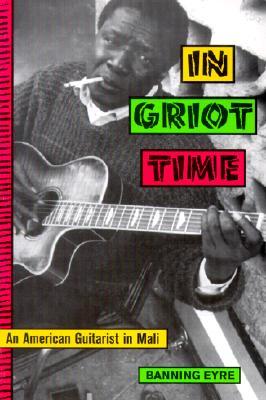
As African music continues to grow in stature outside of its continental confines, Malian music receives no small share of the popularity pie. No great surprise there, given the vast wealth of talent within Mali. Banning Eyre takes the opportunity to delve straight into the music scene in Bamako, living and working closely with esteemed guitarist Djelimady Tounkara for seven months in 1995. The result is “In Griot Time”, Eyre’s story of his time there, the music he listened to and studied, and the people he encountered, illustrated more vividly and entertainingly than anything that has gone before.
“In Griot Time” sets a precedent in musicological literature. It is highly informative but not academic, personal yet objective. One of the most obvious qualities is the honesty within the writing. Eyre writes with truth about the artists he meets, about his thoughts and reactions to his surroundings, and about Malian society in general. His portrait of Bamako is uncanny, and anyone acquainted with the steamy cities of West Africa will surely enjoy the chance to reminisce through his descriptions of petrol fume hazes, the tendency of local businesses to inflate prices at sight of tourists, the complete lack of privacy, and, most pervasively, the poverty, even for members of extended families such as Djelimady Tounkara’s.
Mande society is multilayered and complex and Eyre illustrates this continuously throughout the narrative. He provides effective description of the traditional three-tiered system of jatigui (nobles), nyamakala (workers, craftspeople), and jon (slaves), and the many subdivisions within this hierarchy. The role of the griots within this society is very specific and yet difficult to thoroughly comprehend for an outsider. One contemporary societal view provides wealth and status for the successful griot. These griots are powerful and their words are said to hold the force of nyama, which makes them both feared and respected by those of whom they sing. In stark contrast, Eyre also tells of Adama Tounkara, a young griot with whom he is closely connected during his time in Bamako, who has been denied permission to marry the mother of his twin babies, purely because of his griot status.
If you are after a general and simple insight into the music scene and music makers of Mali, this book is also useful. It is hard not to envy Eyre as he continually name drops and socialises with the superstars. Working with Djelimady, later Toumani Diabate, regularly bumping into names such as Oumou Sangare, Habib Koite and Salif Keita, In Griot Time accurately depicts Bamako as the hotbed of artistic activity that it is.
What is refreshing, however, is the manner in which he discusses these encounters. Reviewers and critics of world music (indeed, all genres of music) are so quick to write gushing articles about their subjects, often painting them inaccurately as larger than life. Eyre tells it like it is, avoiding the tendency to weave a web of mystique. It is fascinating to hear of the practice sessions and logistical difficulties of acts such as the Super Rail Band, surely a legend unto themselves. The frustrations and setbacks of the industry in Mali are as omnipresent as the successes. For me, this honest, human approach is refreshing and real.
Most of all, this is a well-written, entertaining read. Let us hope to see more of the same quality in African music writing in the future.
(Temple University Press, 2000)

