
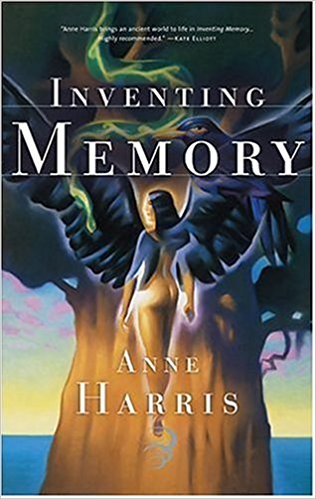
 Elizabeth Vail Penned this review.
Too many people these days seem to confuse “feminism” with “radical feminism” The idea of a science fiction and fantasy novel mixed with a heavy dose of feminism may have people thinking about army-boot-wearing, goddess-worshipping, man-hating, unshaven-leg-baring lesbians. They wouldn’t be completely wrong — many of the interesting female characters in this book wear army boots, worship goddesses, snipe at men, and prefer the touch of the female sex. Just not all at once. Both thoughtful and thought-provoking, Anne Harris’ novel Inventing Memory explores the entire spectrum of female empowerment (or lack thereof), from the passive battered wife to the determined female scientist to the crusading — and yes, lesbian — pro-choice activist.
The novel truly revolves around two stories, which, while they are separate at first, come together in intriguing ways later on. Upon opening the book we are first introduced to Shula, a young slave in the city of Erech in ancient Sumeria, who gains the (mostly unwanted) attention of Erech’s goddess Inanna, who elevates the slave to the status of priestess and has the girl lend a helping hand in running her mythological errands. Shula follows along dutifully, but her heart rests somewhere else, with a banished rival goddess named Belili and her serpent.
The plot moves on from ancient Sumeria to the present day, where a tormented junior high student named Wendy is comforted by her imaginary friend Lili and her snake buddy Hister. This contact allows her to find her individuality, fall in love with abused artist Ray, surround herself with empowered female friends, and grow into an articulate graduate student searching for evidence of ancient matriarchies in Sumeria in order to find evidence that her secret friend Lili really existed. When her own research comes up empty, and her University displays its reluctance to support ‘feminist studies’, she turns to more drastic measures to meet her ends.
Anne Harris manages to ask a great deal of questions about a great deal of subjects that would rarely be related in the conventional sense. The fantasy and science fiction elements help to bundle up the numerous themes (feminism, religion, politics, identity, and a great deal of others things that aren’t appropriate for the dinner table) into a well-organized and satisfying novel. While many of her characters do adhere to a few of the man-hating ‘radical’ stereotypes that have been misapplied to feminism, those flaws are portrayed for what they are: flaws, that each character must learn to come to grips with in their own way.
Anne Harris’ lovely novel succeeds in casually exploring the physical, spiritual, sexual, artistic, and technological definitions of women. While it may be a tad light for serious study, it is worth reading if one wants to gain a peek at the spreading domination of feminist thought.
(Tor, 2004)
