
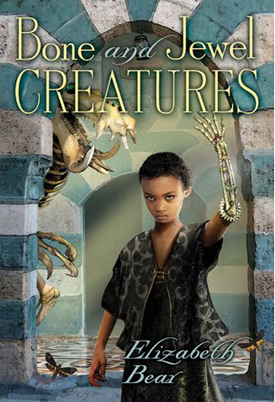
 Elizabeth Bear’s novella Bone and Jewel Creatures takes us to a bizarre fantasy world that Bear doesn’t describe so much as imply.
Bijou the Artificer is a Wizard of Messaline; she makes Artifices out of bone, wire, and jewels. Sometimes they are more-or-less faithful reproductions of what they had been in life, such as Lucy, the sparkling gorilla or Lazybones, the mirrored sloth; sometimes they are pure fancy, like Ambrosias, a giant centipede made of parts of other animals, her oldest and best-loved creation. And then one day her former apprentice, Brazen the Enchanter, brings her a wounded feral child — one hand is deformed and now badly infected. Bijou sees no choice but to amputate; she will use the bones to create a prosthesis for the child. She discovers, however, that the infection was deliberately induced. And then a raven, corrupt and rotting, flies over the back garden wall; dead, it refuses to stay dead, and the evidence begins to point to Kaulas the Necromancer — he and Bijou — and, as it happens, Brazen — have a history, and not a happy one. Kaulas is inviting a showdown.
It’s a low-key story, as so many of Bear’s creations are, thoughtful and rich. The context and characters provide as much interest as the overt events, or perhaps more. Bijou is old — she’s been a wizard here for eighty years — and she’s not interested in defeating death so much as giving it a run for its money. Brazen cares for her like a son — and, as we discover more of their relationship, that’s not really a surprise. He’s also a man of the world, wealthy by most standards, and familiar with the corridors of power.
Bijou, one the other hand, knows the players and really doesn’t care all that much.) The child, whom Bijou names Emeraude but who thinks of itself as the “cub,” has its own take, its own priorities, based on the standards of the pack.
The tension in the story comes not from what happens so much as from what’s hinted. There are undercurrents here, histories half-guessed, ramifications only surmised, relationships not explained. The purpose of Brazen’s interview with the Bey is never openly broached, and the Bey’s reluctance to commit himself to open aid against Kaulas — as ineffective as it might prove to be — is expressed in circumlocutions that almost become parables. It’s not until Brazen’s later, sardonic summary of the meeting for Bijou that we’re really sure what happened. And that encapsulates the tone of the book: Bear has developed a way of describing the concrete that hints at much wider things, much deeper themes, leaving it to the reader to make the connections. Anyone who has read other commentaries of mine knows that this is the best way for a writer to win my heart.
It’s a brief story, with no more flesh than it needs, much like Bijou. And it’s a good one.
(Subterranean Press, 2010)
