
 Books on cryptozoology tend to run the gamut. On one end, you have deadly serious scientific approaches penned by folks like the late Dr. Grover Krantz; on the other you have unedited, unreadable first person accounts of sasquatches who keep chupacabras as pets and hang around farmhouses communicating psychically with the inhabitants. The territory in between, as you might expect, is colorful.
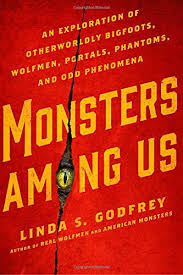
At first glance, Linda S. Godfrey’s Monsters Among Us: An Exploration of Otherworldly Bigfoots, Wolfmen, Portals, Phantoms and Odd Phenomena looks like the sort of title that could potentially muscle its way out of the overcrowded neighborhood frequented only by the converted and members of CSICOP looking for something to get mad about, and into more mainstream territory. The cover, with a single staring eye peering out through a knothole in a fence, is tasteful and the design is clean. Godfrey herself seems like a good choice to cross over the mainstream. She first rose to prominence by introducing the so-called “Beast of Bray Road” – an alleged Wisconsonian werewolf – to the national audience. A professional journalist, she quickly became a go-to interview for various cryptozoological documentary shows, even as “dogman” and “werewolf” sightings exploded in number.
And that is why the book is such a massive disappointment. Pitched as kindred to Loren Coleman’s seminal Mysterious America, a rambling and informative walk through some of the country’s more interesting bits of high strangeness, it instead comes out reading like Nick Redfern’s Three Men Seeking Monsters, a well-intentioned and good hearted book that nevertheless is so utterly credulous as to test any reader’s patience.
Godfrey’s style is much more down to earth and journalistic. Over and over, she picks an incident, interviews witnesses, tries to make sense of the whole thing, and sums it up in a semi-organized shorthand that, since it’s right next to the case it’s summarizing, isn’t useful for any sort of analysis or cross-comparison. Far better to have had all of the case summaries offset in an appendix to allow for ease of comparison, and to avoid the feeling of repetition the straight-through reader is bound to develop.
To give Godfrey credit, she is an excellent interviewer. Her subjects open up to her, and she presents their stories in readable, sympathetic fashion. In many cases, she goes out and explores the sites in question; there’s no question of her commitment to the material.
The problem is, however, that she takes pretty much every witness account as straight truth. And that’s the problem with the whole book. She states flat out at the beginning that she’s not there to pass judgment on what people have seen, but in a case like this that’s a cop-out. And really, she does pass judgment implicitly by trying to tie together all the stories of shape-shifting subterranean tunnel monsters, glowing werewolves in upstate Pennsylvania, UFOs, bigfoots in major urban parks, two-dimensional supernatural critters, mist-beasts, and biblical references. Eventually, all but the most credulous reader will cry out for a little more objective analysis. By trying to cast everything as equally plausible, Godfrey instead ends up presenting them as all equally implausible.
At least the book is an easy read. Godfrey’s style is clean and readable, and she draws entertaining answers out of her interviewees. If you read the book in bite-sized chunks and focus on the storytelling, it’s enjoyable enough. It’s just when all the bits come together that the flaws demand to be noticed.
(TarcherPerigee, 2016)
