
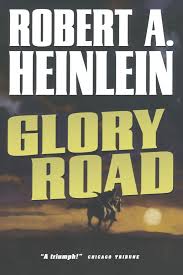
 Before I get started on reviewing Glory Road, let me commend Tor for releasing Glory Road in a very nicely packaged hard cover edition, as it apparently hasn’t seen a hardcover edition since its original publication!
If this were a play, I’d tell the theater company to drop the last act and keep the first two acts — or else risk the groundlings throwing things, including rotten eggs, at them. Why this is so is a tale I’ll tell in a while, but first let’s talk about Glory Road as a novel that reflects Heinlein’s transition (of sorts) from writing juvenile fiction to writing what would later be called his World as Myth novels. Some of you here will have read The Number of The Beast but in case you haven’t, let’s let Jack Merry, who reviewed it, sum it up:
Heinlein was a science-fiction writer, not a fantasy writer, even when he melded the two motifs, as he did in The Number of The Beast, where John Carter of Mars meets the inhabitants of the Emerald City of Oz. (Bear with me, this gets complicated!) The basic plot of this novel is that four terribly sex-crazed, smart-arsed and extremely smart people, all of them with more Ph.D.s than are good for them, travel off in a very talkative spacecraft complete with a bathroom installed in Oz (!) for a series of adventures that Heinlein ‘steals’ from the favourite tales of his childhood. Heinlein, to my thinking, isn’t interested in fantasy at all in The Number of The Beast — he’s interested in putting his characters in very odd situations. Heinlein clearly believed in a multiverse where everything was possible.
I’ve read The Number of The Beast a number of times (pun intended) and found it an enjoyable romp. What I didn’t realize was how much of it was a rewrite (in large part) of Glory Road! The basic premise is straight forward — discharged from an (un)war in Southeast Asia, ‘Scar’ Gordon sits in a cafe in France hoping to win the Irish Sweepstakes so that he can attend school in Heidelberg. Into his life walks a beautiful naked woman who takes him on a quest to retrieve the Egg of the Phoenix in order to save all the Known Universes. Assisted by Rufo and his magic box that holds everything from a ten course lunch to all the weapons Our Hero would need, he and they encounter dragons, golems, and almost anything else you’d care to mention. (I particularly liked the rodents of an Unusual Size.) Our Hero and She Who Must Be Obeyed as She is the Empress of the Twenty Known Universes eventually do get together after Our Hero spends too much time being honorable.
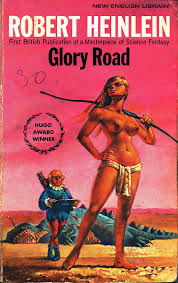 (She’s naked. She’s willing. She’s got great tits, errr, breasts. Heinlein certainly makes sure we, the readers, know this. More often than need be. I’ve included one of the earlier book covers from a mass market paperback in which the artist depicts her character according to the text.)
Oscar (as She calls him as She garbles his name which is E.C. ‘Scar’ Gordon) even refers to himself looking like John Carter of Mars as he’s wearing nothing but his sword at one point during the quest. I do hope he’s very carefully when he sticks his sword back into his scabbard!
I won’t detail how they are similar, but a lot of characters, descriptions, and even plot from this book end up in The Number of The Beast. More than one would suspect unless one was paying attention, so do pay attention!
(I want to stress at this point that not once in the novel does Heinlein actually name the (un)war — his term several times for it — in Southeast Asia, but almost every damn reviewer thinks without hesitation on their part that it’s the Vietnam War. Might be, might not be. It was published in 1963 which suggests it was written at least a year earlier, so it may or may not be reflective of Heinlein commenting on that conflict. Judge that on your own.)
What we have here is a book that really does have two terrific pieces, the set-up leading up to the adventure, and the adventure itself which is as good as any I’ve ever read. It’s witty, it’s fast paced, great fight scenes, and so forth. The Hero gets The Princess (his name for her), no one gets seriously hurt, and the treasure is recovered from the Really Evil Ones who took it from those to whom it belonged. A really good tale that will keep you turning pages late into the night is told, and I enjoyed every word of it. Well, mostly — the lectures on why Democracy doesn’t work are Heinlein at his very worst. Yes, I skimmed those parts.
Can you guess what happens after the glory road has been followed to its very end? Not much it turns out. The Hero gets very bored — even the love life goes seriously flat — as he has nothing to do and the Empress of the Twenty Known Universes is busy, well, being She who is responsible for the very loosely knit Empire which runs by the Golden Rule, i.e., blow up your planet but not that of your neighbor! There are seventy-five pages left after the glory road is no more — seventy-five pages, all so boring that my teeth started to ache. Lots of lectures too. Arghhhh!
So buy it for the glory road and the wonderfully drawn characters who trod upon that path full of glory and dangers; it’s worth it for that part alone. Just don’t ask me to re-read it. And do read Samuel Delany’s afterword for his reflection on how Glory Road was received by sf readers and critics alike at the time of the original publication. Lets just say Delany likes the novel a whole lot better than they did!
Is Glory Road fantasy? Maybe, maybe not. It’s certainly the genesis of his later World as Myth tales, which blend hard sf with fantasy. Now excuse me as I want to leave before the groundlings start throwing rotten eggs at the stage for that horrible third act!
(Putnam, 1963; Tor, 2004)
