
 There is something particularly stirring about work songs of anyculture. The rhythmic, repetitive strains speak volumes of thesociety for which they were first sung. The sound and choice of thewords, the pattern of call and response, and the method of deliveryall reveal the nature of the work that was done to these tune timecapsules. The words are usually easy to pick up, and the songs passdown readily from generation to generation even after the work ceasesto require something to pass the time.
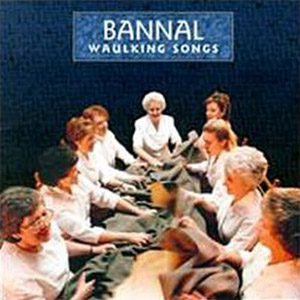
One of the gems of Scottish heritage are the “waulking” songs,used to break in the native tweed before the cloth was fashioned intoclothing. Waulking (or fulling) the cloth was done by a group,usually of women, who would sit around a table, rhythmically beatingthe cloth onto the table, and then pushing that section on to the next worker. This beating of the cloth made it softer, more flexible,and more supple. It was a necessary part of the tweed-making process.
The songs for this process are true folk songs. The themes varywidely, although most of them tend to be about love in some fashion or another. There are songs of lost love, desired love, tragic love,scorn in love, bashful love, and untrue love. Sometimes the songsincorporated a familiar folk tale within the words or a descriptionof the singer’s home land. The lyrics tell much about the thoughts and feelings of the original singers, thus revealing much of theculture of the day.
No fan of waulking songs should be without this recording. Thisensemble of nine native Gaelic speakers presents an authentic and enjoyable look at sixteen waulking songs and two clapping songs, presenting them in an authentic manner. The voices are unaccompanied,with the exception of the beating of the cloth in the background. Thecall-and-response format is kept true to tradition, and the speed of the tune changes as is appropriate to the tune (and, assumedly, the work to be done.)
Eight of the women take turns in the role of leader, keeping thesound of the vocals varied and interesting. The rest of the womenform the chorus for the response, sometimes adding in sounds ofexcitement in response to the lyrics of the songs. The rhythmicbeating is prominent, as is required for authenticity, but not sooverbearing as to cover any of the wonderful vocals. The recording iscrisp and clear.
The character of the tunes changes, depending on the lyrics, thesinger, and the work to be done. There are upbeat songs, such as “HeMo Leannan, Ho Mo Leannan.” This tune talks of the beauty and skillof a girl’s love; and when slighted by her man, she states howunimportant it is, for after all, she’s already found another. Aslower, more stately tune, “A Bhean Ud Thall, Gu De Th’orr’ Aire?”speaks of the singer’s worry for the missing ships out to sea. Thewords of “Dh’Eirich Mi Moch Maduinn Cheitein” describe the beauty andjoy of the countryside awaiting the early riser. The quick andrhythmic clapping songs are used for rolling up the cloth once thewaulking is complete. One of these, “An Long Eireannach,” asks “Whomshall I take with me on the Irish boat?”
One of the great treasures of this recording is the wonderfully crafted liner notes, with complete lyrics in both Gaelic and in anEnglish translation. This allows the non-Gaelic-speaking listener tofollow along, and even sing along with the responses, while seeingwhat each song is actually about.
(Greentrax, 1996)
