
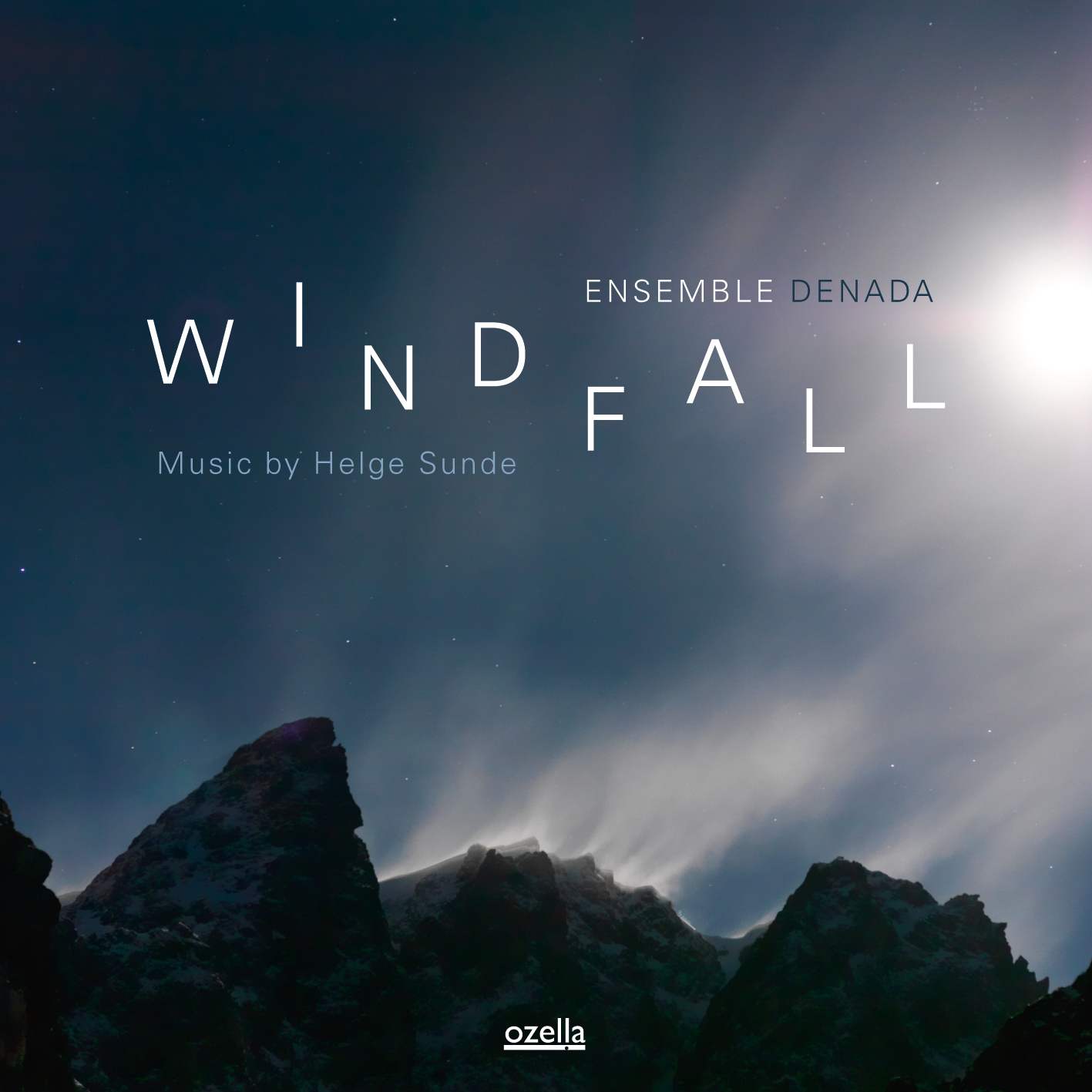
 Ensemble Denada is the creation of Norwegian composer and trombonist Helge Sunde. It’s a 15-piece orchestra whose music falls under the rubric of jazz, in much the same way that Frank Zappa’s music was considered rock — an arbitrary category for music that fits none of the available ones. The musicians and particularly Lunde are inspired by Zappa and those who inspired him including Varese and Stravinsky, as well as modern jazz ensembles like Weather Report and more traditional jazz figures from Bill Evans at his most pensive to Miles Davis at his most incendiary.
Windfall, released in late 2013, is a big, joyous, sprawling affair with continuous surprises. That’s hinted at in the album title, an English word that has more than one meaning. It can mean fruit blown off a tree when it’s ripe or perhaps a little too early; maybe it’s your neighbor’s fruit and it falls in your yard, which can be nice. The word can also mean any kind of unexpected bit of good fortune. As the album’s publicity one-sheet points out, it is indeed full of unexpected juxtapositions of sound and noise that combine in unexpected ways.
The ensemble has a brass section and woodwinds, and what amounts to a piano quartet with guitar, bass and drums. Plus some electronics, or “percutronics” as they’re called in the liner notes. And something called a “tubax” which makes its appearance in one of the most amusing and enjoyable pieces, called “Moosic.” At first I thought it was perhaps a tuba being played with a saxophone mouthpiece, but now I’m convinced that it’s a bass saxophone played with a tuba mouthpiece. Apparently inspired by a moose swimming in a West Norwegian fjord, this piece starts with a tubax solo, then mutates into a driving piece in 5/4 with some exciting brass-section parts and kicking solos from trumpeter Marius Haitli and alto sax player Børge-Are Halvorsen.
Here’s a video of a live version of “Moosik,” unfortunately without the tubax but with a great intro by Nils Jansen on bass saxophone:
Bass sax is rare enough, not to mention tubax, but the band also draws on the unorthodox sounds of the contralto clarinet, alto flute, bass clarinet and flugelhorn.
Three of the works were inspired by a famous Norwegian poet named Olav H. Hauge: the languid, melodic “Seven Winds,” which treads a little close to smooth jazz territory; “The Entire Truth,” which has lots of electric guitar and noirish chords that call to mind Jack Nitzsche’s early-’70s symphonic work; and “The Arrow,” the final and most experimental track that ends with a recitation by Hauge of one of his poems.
What remains is the manic, Zappa-esque opening track “The Speedcouch,” apparently inspired by a typographical error; and “(The Road To) Damascus,” which is by turns dramatic and somber as befits a piece inspired by the current plight of the once-cosmopolitan capital city of Syria. The band played there just before the uprising and violence broke out in 2012. The central section, a big-band bop workout, is the most dramatic on the album, particularly the soaring brass fanfares that bookend it, and Atle Nymo’s central tenor solo.
This band obviously is one that would be incredibly exciting to see live. You’ll find a tour schedule on their website. But the next best thing is this superb recording. For the adventurous only.
(Ozella, 2013)
