
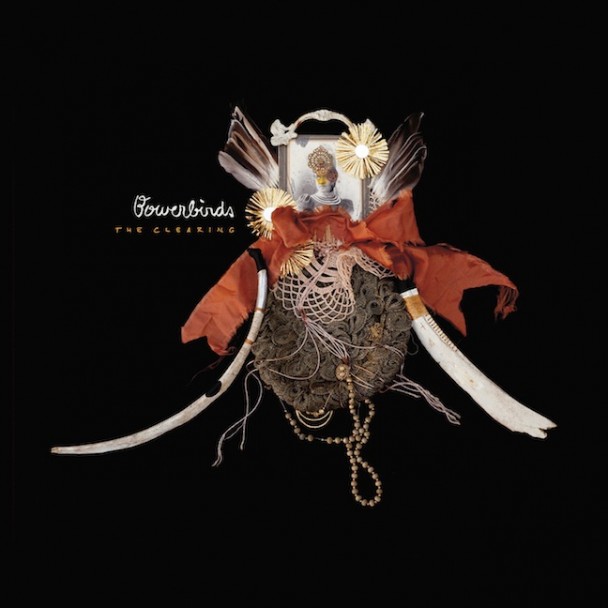
 The Clearing is a fully realized artistic vision of Beth Tacular and Phil Moore, the young North Carolina couple who perform as Bowerbirds. It’s their third album, and it’s a mature, emotionally charged work that reflects some of the travails and victories they’ve lived through since their 2009 outing Hymns For A Dark Horse.
To understand the album and its emotional heft, take a listen to its opening opus, “Tuck The Darkness In.” Phil sings lead on this magnificent piece of chamber folk, his words detailing the ravages and triumphs of living the examined life: “Before the hours took over / before the full weight was on our shoulders / before the twilight’s cover / before I knew time was such a swindler…” he sings in one of the final verses, punctuated by Beth’s non-verbal crooning. It starts with simple instrumentation and crescendoes to a wall of sound that leaves this listener stunned and wrung out. The song’s official video further explores the themes of death and rebirth.
The whole album trucks in the kind of metaphors that move from the personal to the universal. Fields get plowed, crops grow, things are built, pieces are joined together, trees and crops sleep through the winter in anticipation of acquiring new life come spring. Most often, the songs begin simply, then slowly build to a climax, the soundwall giving heft to deceptively simple lyrics (as in “In The Yard” with its imagery of “squirrels in the rafters, wrens in the eaves”) or more complex essays such as “Walk The Furrows,” the title of which builds on imagery from “Tuck The Darkness In.” “Where’s that horse you rode in on,” Phil sings to his younger self. “Where’s that fair faced young man … now in a land without leaders, I’ll listen close to the soil beneath me and keep my heart with yours.”
Since their previous record, Beth got deathly ill of some unnamed malady from which she thankfully recovered. And the two broke up, only to come back together again, to return to their cabin in a clearing in the Carolina woods with a dog they rescued and nursed back to health after it ran under their van’s wheels.
So all the imagery of death and rebirth on this record comes honestly. “We need a deeper frost / me and my meadow lie under the winter’s fear / out where the treelines start / down on the north slope, down to the creek / hold tight ’til spring,” Phil sings over gently plucked arpeggiated chords, the rhythm set by a sketchy tom-tom and hi-hat, on “This Year.”
Another theme running through The Clearing is a sonic one. On nearly every song they make use of non-verbal vocalizations, croons and sighs and the like. They don’t serve merely as punctuation or take the place of words, these “oooh-oooohs” and “aaaaahhhhs.” They highlight the emotions, the longings, the enlightenments. In “Hush,” they begin the song with a hymnlike sound, echoing as in a cathedral.
In the sparsely accompanied “Overcome With Light,” Phil’s humming gives voice to his amazement at finding grace amidst all the darkness:
And yes the weather was not always great / but the furrow always graced my brow / mmm-mmm, mmm-mmmm, MMMM-MMMMM / now I’m overcome with light, overcome with light … yes we had some hard work but now it’s right.”
And at just the right times, a string quartet adds its sweet strains to the plucked classical guitar and sighing harmonium.
The final two tracks bookend the album’s themes, with “Death Wish” leading into “Now We Hurry On.” In the former, Phil sings in his lightly drawling tenor of regaining his desire to go on. The song is a shambling waltz that builds to a howling climax and threatens to deconstruct itself as a skronking sax and other instruments tear in from left field. Finally, when all is cacophony, a string quartet enters and soothes the waters, and the song melds seamlessly into “Now We Hurry On,” a nearly seven-minute, multipart song about finding peace in a solid relationship. First, in a stately elegiac melody over simple piano chords, he sings “No you’re not alone, the sun pours in slow, the hinges creak, now the sparrow’s know and flash their wings…” The middle section segues into a latin rhythm and both sing, “Down the red dirth path me and my true love, we thought we’d have forever and now we hurry on… We used to see the forest now we see the trees, we know where this is going…” and it returns to the former melody for a long, languid fade-out.
Bowerbirds’ previous successful albums brought them an audience and the wherewithal to add all these sonic elements to their formerly simple folksongs. But to my ear the embellishments aren’t used frivously, but instead always serve the songs by heightening their meanings.
I’m glad to have made the acquaintance of Bowerbirds music. These young folks apparently have learned some life lessons and put them to work in their art. I hope to catch them in performance someday soon. Meanwhile, you can watch a short documentary film about the story behind the making of this album on their website or check out their tour dates as well.
