
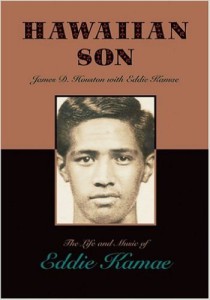
 I think I’ve told the story here before, about how I met Eddie Kamae, in a music store in Honolulu. I was trying out a Rainsong guitar. He was carrying his oversized ukulele and testing out a microphone. I had no idea that the man I was speaking with — chatting about musical instruments — was the legendary Eddie Kamae. In fact, it was his wife Myrna who continued chatting with me about music and where one might find the authentic slack key players in contemporary Hawaii. All I had seen so far was duets singing “Country Roads” or “Margaritaville” to pseudo-Hawaiian rhythms. She said “Do you know who that is?” I replied, “No.” And when she told me I had been talking to Eddie Kamae, I was stunned. I had tried for twenty years to obtain a copy of the famous Five Faces album, and it had finally been reissued on CD. It was like meeting one of the Beatles. I shook Eddie’s hand, got his autograph, and thanked Myrna for the introduction. It’s one of those moments I’ll never forget. And now with the release of this book (and CD, which is available separately) we can be reminded of his talents, and his gracious spirit again and again.
Author James D. Houston states in the Foreword:
I welcomed the chance to meet him. I would have paid money to shake his hand. He is the Willie Nelson, the Woody Guthrie of Hawaiian music: composer, band leader, legendary instrumentalist . . . [he] is among those who, by pursuing his own singular path, has found a way to reclaim his heritage and in so doing inspire others . . . Today . . . he is recognized as a ‘living treasure of Hawai’i.’
It was not always thus.
Born in 1927, Edward Leilani Kamae grew up close to the downtown section of Honolulu. He was the seventh of ten children. He got by at school, but “classwork never held his attention for long.” His brother, a driver on a city bus, found a ukulele on the bus, and brought it home. Eddie found his passion with that “jumping flea.” He also found other interests. As a teenager he was running dice games in the boys’ lavatory at school. He was such a problem child that the principal recommended he join the army. Japan had surrendered, but it was a way to end the gambling and clean up the school. After the stint in the Army, he came back to finish high school, but the call of the ukulele was much greater . . . so he quit only one credit short. He began playing in clubs. His facility on the uke was amazing. He toured the US with bandleader Ray Kinney, and suffered through bad hotels, cold weather, and lack of pay, before giving it up and going home. The return to Hawaii meant a return to gambling, which led to petty crime, and jail time. Three years in jail allowed Eddie time to play the ‘ukulele, and time to think. He was finished with gambling.
The real Eddie Kamae story starts then, with gigs at The Biltmore, a good band, pretty girls . . . and Eddie’s ‘ukulele. It was there that he met other great Hawaiian musicians, the king of slack key guitar Gabby Pahinui, bassist Joe Marshall and others. Association led to jam sessions and finally to the creation of a group of like-minded musicians who sought to bring traditional Hawaiian music into the forefront. They’d been playing jazz standards and popular songs, but what if they could play their own music? The Sons of Hawaii did just that. Eddie began a journey that would last his lifetime.
He started researching the old songs. He scoured the libraries looking for sheet music. He hunted down legendary musicians, and worked with Mary Kawena Pukui to find the sources. He rearranged the songs of Queen Lili’uokalani. And he played these songs on stages, in bars, nightclubs, and on a series of recordings that marked the rebirth of interest in genuine Hawaiian culture.
The book traces the history (and multiple personnel changes) of the Sons of Hawaii, and then follows Kamae into his career as a film-maker, documenting the history of Hawaiian culture in a series of award winning (and from what I’ve seen, very entertaining) films. His series of films is available on VHS, except for the one about the Sons of Hawaii which is now out on DVD!
Through it all, author James D. Houston presents a warm and loving portrait of a true Hawaiian Son. And Eddie’s own comments display a very gifted man with a love for his own land, culture and people. Add a wealth of photographs, a discography, filmography and chronology, all put together in a stunningly designed volume that simply feels like quality, and Hawaiian Son provides an endearing look at an enduring talent.
(Ai Puhako Press, 2004)
