
 Brendan Foreman penned this review.
The traditional music of the European continent has tended to get a short shrift here in the States. This is most likely due to the fact that the majority of Americans who claim ancestry from Europe, claim it from Ireland, Great Britain and the like. Not to mention that Continental traditions tend to be overly associated with bad, Lawrence-Welk-ish versions of polkas and waltzes. Happily, this situation is changing, especially as the former Iron Curtain nations continue their unthawing, and more of those cultures are being introduced to the American audience.
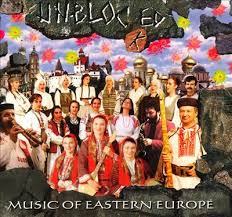
An excellent place to start is this 3-CD set, which presents a fairly coherent cross-section of the various Eastern European musical styles, beginning with Poland and the Baltic States and ending south in Macedonia and Bulgaria. Just giving the listener a good set of music to represent such a broad set of cultures would have been good enough (which they did), but the good folks at Ellipsis Arts also provide great liner notes, that describe the music, culture and history of many of the Eastern European people. Although the Jewish population of this area gets scant notice, I found it remarkable that there is an emphasis on the contributions that the Romany people have made to Eastern European culture — as well as the great injustice that they have received.
Unblocked begins its survey of Eastern Europe along its northern section, starting with Belarus and Ukraine, moving over to Poland then ending with the Baltic states of Estonia, Lithuania, and Latvia. As its title — “Eastern Voices, Northern Shores” — indicates, this first CD concentrates mostly on the vocal and choir traditions of these lands, beginning with the chants of the Unija Male Chamber Choir in Belarus and continuing with the polyphonic sounds of the Litwins, an early music group who specialize in the Lithuanian-derived musical traditions of Belarus. From the Ukraine come a spring celebration called “Vorotarchick (Gatekeeper),” sung by the Ensemble Berehinya, and a festival field recording by the Drevo Ensemble. The women’s choir music of “Tek saulite tecedama (The sun keeps rolling)” adapted by Latvian composer Jekabs Graubins from a traditional song, sounds almost medieval in its etherealness. Later, in the Estonian section, the listener is treated to the sound of 10,000 Estonians singing at a song festival.
There is much more here than just choirs. Besides a medley of fast-paced dance tunes as played by the Ukraine’s Cheres, there is also substantial evidence of the influence that modern idioms like jazz have had on this region. Ukrainian Enver Ismailov turns “Kopanista,” a traditional Bulgarian 11/8 dance into a jazzy, ethereal guitar tune, while the Polish group Zbigniew Namyslowski Quartet (accompanied by the Zakopane Highlanders Band) provides a set of jazzed-up version of their own tradition with “Skarga Podhala.”
The CD ends with three musical suites, each of which showcases the music of one of the Baltic States. This region is well-known as being a meeting place for Slavic, Germanic, and Ugro-Finnish cultures. The Lithuanian suite features a quick piece played on the kankle, the Lithuanian lap-harp, followed by three traditional folk songs and a rousing violin polka. The Latvian suite also starts with a lap harp tune (“Jana Porika Polka”) but ends with three traditional songs which feature some very haunting polyphony. Lastly, the Estonian suite begins with the aforementioned 10,000+ choir and ends with Estonian composer Veljo Tormis’ atmospheric arrangement of the ancient rune song “Call for the Midsummer Bonfire.”
The second CD “From the Danube through the Carpathians” explores the central section of Eastern Europe spanning from the Czech Republic to Romania. Although the geographical area covered by this CD may seem small when compared to that of the other two CDs, from the very beginning of this CD you can hear what makes this area so special musically: bagpipes! In fact, the drone of various types of bagpipes is pervasive throughout these tracks from the almost medieval sounds of the Slovenian song “Godci godjo” and the Bohemian ensemble piping tune “Chodska Kolecka” to Moldavian “Majd Megvalik,” a sprightly song about a girl’s coming of age. It turns out that the bagpipe — of course, one of the oldest and most pervasive instruments in Eurasia — has a long Hungarian tradition. Bagpipe revivalists Ujstilus help prove this with a hauntingly beautiful set of Hungarian piping tunes. There is something almost primal about this music. In some ways, it feels more natural than the much more familiar Scottish tunes that one usually hears played on the bagpipes here in the States.
Naturally, bagpipes are not the only focus in traditional Central European music. Folk heroine Marta Sebestyen, accompanied by the Okros Ensemble, is represented by “I’ll walk under the starry sky,” a strident song with a rather syncopated violin accompaniment. The Szaazcsavas Band plays “Gypsy Lament,” a surprising well-done field recording about a jailed man trying to make bail, while from Romania Dumitru Farcas plays a triplet of Romanian dances on the oboe. There is even some klezmer, here represented by cimbalomist Tony Iordache playing a hora. The CD ends with another chronicling of injustice against the Rom, “Mudarenas tut le Rrom (They killed Rom there),” played plaintively by a brothers-and-sister combo called Rromane Gitare.
The third CD “The Balkans” starts with the music of Slovenia and moves its way around the Balkan peninsula, touching upon most of the major cultures and peoples of that region. As with the previous two CDs, “The Balkans” offers a superb slice of the traditional musics of the region: women’s vocal music from Slovenia, quick-paced and highly danceable kolos from Croatia, mesmerizing saz music from Bosnia. Fans of Three Mustaphas Three will recognize the Macedonian circle dance tune, “Ovcepolsko Oro,” here played by the Ensemble Pece Atanasovski.
Rather than completely flit about geographically, though, three regions do get more of the spotlight than any others: Serbia, Albania, and Bulgaria. The Serbian people represent one of the oldest and most dominant cultures of the Balkans; they were causing trouble for the Byzantines way back in the 10th century! Wind instrumentalist Darko Macuro plays “Svirka za spas,” an otherworldly set of melodies played on a large pipe called the duduk. And the CD provides two fine examples of the musical form that Serbia is most famous for: the brass band. Imagine J. P. Sousa writing gypsy music with a dash of swing, and you get pretty much the idea of how this music sounds.
The Albanian tracks have a definitely more Eastern feel to them than many of the other songs here. Merita Halili, one of Albania’s most popular singers, shows her emotional range with a song of unrequited love, “Ku t’ka lala moj kumri (Where on Earth have you been hiding?).” The polyphonic song “Legend of the Walled-in Woman” demonstrates one of Albania’s oldest musical traditions. According to the liner notes, the title of this thoroughly haunting song refers to an old tradition of ensuring the sturdiness of a new structure by walling up a virgin inside it (this tradition could possibly be related to an old Celtic tradition alluded to in the novel Hawkmoor by Peter Ackroyd).
The CD (and the whole CD-set) ends in Bulgaria, one of the great cultural gateways of Europe. Some attempt was made to represent as many of the seven musical regions of Bulgaria. From the Thracian region comes a field recording of extremely Turkish-sounding dances. From the Rom of Bulgaria, we get the Yuri Yunakov Ensemble’s “Radomirska Kopanitsa”; and from the Pirin district we get the polyphonic sounds of the Bisserov Sisters. The CD ends with one of Bulgaria’s most famous sounds: the women’s choir, here represented by The Bulgarian Voices Angelite singing “Mechmetio” by the composer Philip Kutev.
Good, accessible recordings of Eastern European music used to be the bailiwick of only such heavyweight groups as Muszikas and the Trio Bulgarka, a situation which provided some great music but not so much variety. But with such recordings as Unblocked, the current listening American public has access to a great span of well-done, highly listenable traditional music.
(Ellipsis Arts, 1997)
