
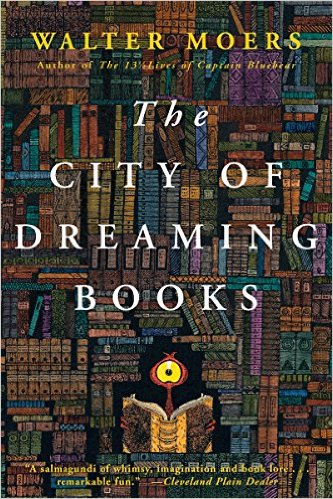
 This is a very clever book. The full title page proclamation reads, “The City of Dreaming Books: A Novel from Zamonia by Optimus Yarnspinner, Translated from the Zamonian and Illustrated by Walter Moers, whose German Text was translated into English by John Brownjohn.” It’s also intensely decorated, that page. Top to bottom. Stacked and piled and packed in together are a pageful of books, illustrated to the minutest detail in black ink hatchmark scratchings. One loses oneself, counting and studying the fine detail of marks on paper; it’s so dense, it almost hurts to look at it. While the drawings are wonderful throughout, the story is as chock full of detail as that very first illustration. After awhile, it’s difficult not to feel oppressed by so much detail, so much weight. It’s hard to keep focused on the story buried within the crazy pages crammed so full of stuff.
First, the story. Optimus Yarnspinner, our young hero (who’s not human by the way — there’s nothing even remotely resembling a human in form or deed in this entire story, which is one of its strengths) lives in a fantastical community of dinosaur-type beings dedicated to the written word. Reading, writing, even cataloguing and storing books is everything to these people. Yarnspinner’s beloved “authorial godfather,” Dancelot Wordwright, bequeaths to him his cottage, his library and garden, and the most glorious manuscript ever beheld by beast or . . . beast. In a quest for the glorious manuscript’s author, Yarnspinner ventures forth to Bookholm, also called The City of Dreaming Books.
The number and variety of adventures (and misadventures) to befall Yarnspinner on his journey are as tightly shoved together and as lovingly detailed as the cross-hatched illustrated minutiae on the title page. Bookhunters, Booklings. Monsters. Poison; dangers lurk around every bend and twist in this labyrinthine tale.
Truth be told, it’s easy to lose one’s way in all that detail. What at first seems charming and fresh (the silly and bizarre names, the numerous puns and literary references, the buffoonish personalities of the characters) wears thin rather quickly. The story itself gets thinner and thinner, like a fading trail through an overgrown field. The illustrations are unflaggingly interesting, the folkloric and mythological background of the world unrelentingly rich, but one wonders if the entire novel-length format wasn’t a tad superfluous.
Yet … I still found The City of Dreaming Books fascinating. The thought that someone so rigorously and cleverly (as I mentioned, it’s very clever) translated this complete work from German into English fills me with awe. And the book is worth purchasing — or at least perusing — for the artwork alone.
(Overlook Press, 2007)
