
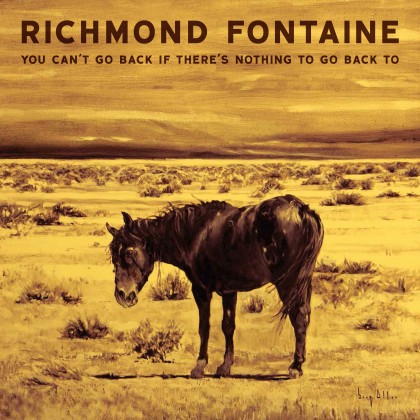
 Richmond Fontaine is capping a 22-year career as Portland, Oregon’s top alt-country band with one of its best albums. You Can’t Go Back if There’s Nothing To Go Back To is the band’s 11th studio album and intended to be its last. Since starting in 1994, they’ve also released a couple of EPs, a single or two, and several live sets. Always popular in the Northwest, RF found its biggest audiences in Europe and the U.K.
Fronted by songwriter and singer Willy Vlautin, the band’s lineup was remarkably consistent for more than two decades, with Dave Harding on bass and Sean Oldham on drums. In the early years, Paul Brainard played electric guitar and pedal steel; since Dan Eccles joined on lead guitar, Brainard (an in-demand session player) regularly sits in and adds color with steel guitar and trumpet. Since their previous release The High Country, a concept album about poverty, meth, love and logging in Oregon’s backwoods that charted in the U.K., Harding decamped for Europe and Freddie Trujillo is playing bass. Meanwhile Vlautin has been having increasing success as a novelist and with a new band, The Delines.
You Can’t Go Back is a mature album in many ways. Everybody here plays like the accomplished professionals that they are, always finding the right note that serves the song. A particular plus is Jenny Conlee-Drizos of The Decemberists on keyboards. And lyrically and thematically, the album reflects the middle-aged concerns of Vlautin and crew. The mistakes made by the guys in these songs are those of adults, not kids, although some haven’t quite grown up. Mostly, these characters are tired, looking for a break, hoping to settle down. “I ain’t got it in me anymore to play around with living so low,” says the guy in “Tapped Out In Tulsa,” one of the album’s high points.
“Wake Up Ray” is a gorgeously sorrowful thing, a stripped-down shuffle in which the unnamed protagonist is trying to rouse his friend so they can leave a town that has been bad for both of them. He’s haunted by the memories of the tumultuous end of a long-term relationship, and baffled by why it ended: “How can someone you love so much grow against you so?”
Sometimes they’ve gone back home only to find that, of course, you can’t go home — as the guy in “I Got Off The Bus,” revisiting what I’m guessing is Reno and finding nothing but old memories and his own failures, but also perhaps the glimmer of some self-knowledge: “I know what you abandon dies / What you leave leaves you too / I know you can’t go back / If there’s nothing to go back to,” he says, giving the album its title. Or the fellow in the even sadder “I Can’t Black It Out If I Wake Up And Remember” going back to Winnemucca. Nobody he knows remains, only bitter memories of a girl he knew who was killed in a car crash, an uncle who was like a father but then skipped town, and his mother working soul-killing jobs and worrying about bills.
Some are only revisiting old memories in their heads, like the guy in the catchy “Two Friends Lost At Sea” who still hurts from a breakup and can’t quit thinking about her with somebody else. This one has a heartbreakingly upbeat melody, enhanced by beautiful contributions from Conlee, Eccles, producer Jon Askew on baritone guitar, and Brainard on trumpet; it’s a great song that won’t get played on the radio because of the f-bomb in the second line.
The epic “A Night In The City” has an urbane feel to it, but the guy in this one is just as lost. He goes out for a night on the town with a friend but ends up sick and alone and questioning everything: “Is this all there is? Is this what life is? … A one-night rebellion that ends up just being a drag …” The guy in “Let’s Hit One More Place” hasn’t quite grown up yet and wants to pull an all-nighter even though he knows better.
“Three Brothers Roll Into Town,” the only song on the album not written in first person, tells of young itinerant workers fleeing a history of domestic violence, trying desperately to support themselves in a scary city with no adult guidance.
How can songs this sad leave you feeling so good? I think one answer is found on “Whitey And Me,” the odyssey of two hard-luck cowboys who keep getting double-crossed but just keep forgiving their betrayers. They’re avatars of the humanism and decency that shine through all of Vlautin’s writing, and for which Richmond Fontaine has honed itself into a perfect vehicle (the songs in fact have always been credited to the band). We’re fortunate that he’s still writing books and making music in other settings, and to have a couple of decades’ worth of recordings to go back to when we need a fix.
Fluff & Gravy, 2016
