
Young Justice is, as you might expect, a DC superhero team of young heroes, who originally appeared as a one-off, Young Justice: The Secret. The core group were Superboy, Robin, and Impulse, who are featured in the first part of Young Justice: A League of Their Own, the beginning of their own series.
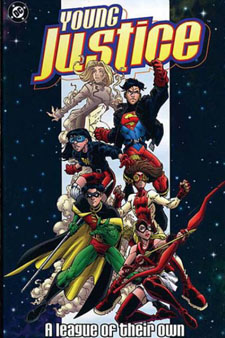 Superboy, Robin and Impulse have set up camp in the Cave, abandoned by the Justice League. They also manage to bring the android Red Tornado out of his self-imposed hibernation: he figures these guys need some adult guidance, or the world is in serious trouble. Along about the middle of the series, after the boys have discovered the Super-Cycle, which seems to have a particular affinity for Robin (it’s not entirely machine), the boys link up with the new Wonder Girl, Secret, and Arrowette.
This collection is quite enjoyable, if you can deal with Peter David’s tendency toward in-jokes and somewhat puerile humor. There are times when the in-jokes work as an acerbic commentary on comics, and other times when they’re just in-jokes which necessarily depend on a certain geek factor in the reader. The caliber of humor can be judged from the boys’ first encounter with the Mighty Endowed, a young archeologist who was transformed by contact with the Super-Cycle and is now so top-heavy she can’t stand without support. Thankfully, it gets better. The target audience can be deduced from some of the graffiti that Impulse comes up with when he discovers a can of spray paint: Red Tornado winds up with “Hanson bites” across his chest.
“Sins of Youth” hinges on the effort of the Agenda to obtain samples of superhero DNA, particularly that of Superman. They retain the services of Klarion the Witch Boy, who promptly changes the ages of all the suprheroes — adults are now children, and teen-agers wind up on both sides of the maturity divide — but mostly, they’re kids. This includes not only Young Justice, but the Justice League, the Justice Society, the Titans, and a few miscellaneous Spandex-clad heroes. What follows is, essentially, chaos.
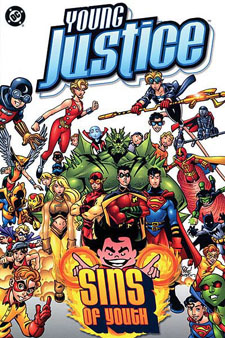 The underlying story line is the rise of public opinion against the young heroes, fed by a media feeding frenzy (and if you don’t think there’s some commentary on current events in that, you haven’t been paying attention). That part gets lost.
The “Sins of Youth” story arc bleeds off into the story of Young Justice’s expedition to Myrg, the home planet of Doiby Dickles, to free his world from invaders.
Frankly, this volume was a chore to get through — not only is the situation chaotic, but so is the story line, and the attempts at humor, such as they are, become stultifyingly repetitive. It probably worked a lot better as single issues — at least, I hope so. There are too many characters to keep track of — there’s even an appearance at the end by Li’l Lobo — and very few of them actually contribute anything to the story.
The art in both volumes, penciled mainly by Todd Nauck, is very appealing, and captures the energy of Young Justice nicely. The other artists who contributed — and they are legion — maintain the overall style. The only exception is Rob Haynes, who drew “The Adventures of Superboy . . . When He Was A Man!” Haynes’ style has its own appeal, quite reductive and still expressive, but it does represent a sharp stylistic break with the rest of the volume. The same holds true for Michael Avon Oeming, penciller, and Jason Baumgartner, inker, in “Looking for Trouble,” which follows Shadow and Dead Boy as they engineer the final victory over Klarion and the Agenda.
Frankly, if I had it to do over, I’d pass on Sins of Youth, even though I found A League of Their Own fairly enjoyable. There’s too much comic with very little point, and I have to confess to one of the sins of age: I expect more substance, or at least more intelligence, in my comics.
(DC Comics, 2000) Includes Young Justice #1-7 and Young Justice Secret Files 1 .
