
 Brendan Foreman wrote this review.
The cello is easily one of the most versatile of all musical instruments. Its midrange tone allows the cellist to provide the musical and emotional anchor of a given piece, much like the bass guitar is utilized in rock and pop music, but it is also high enough to provide the melody as well. Some of the most graceful, beautiful melodies become even more so when played on the cello. Oftentimes, as in a string quartet, the cello lives comfortably in between these two musical roles.
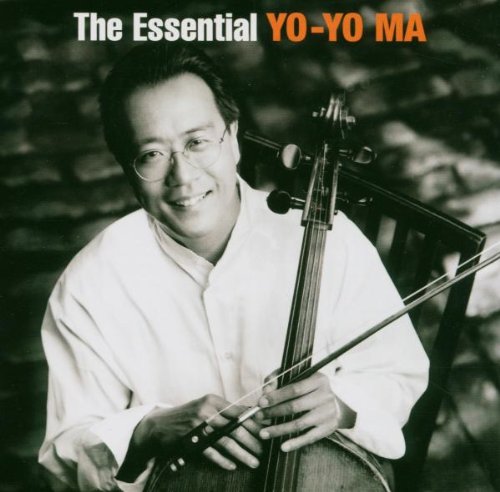
Since his graduation from Harvard University in 1976, Yo-Yo Ma has steadily become one of the most famous cello players in the world by fully utilizing this versatility. He plays with a grace and an artfulness that is a great pleasure to listen to. This 2-CD retrospective presents a broad sampling of some of his most important recordings for Sony BMG Entertainment. The two CDs represent the two main aspects of Yo-Yo Ma’s playing. The first covers his classical music output, the second on his efforts in branching out to other forms. In both cases, we are given a broad variety of interesting, sometimes beautiful music that can serve well as an introduction either to Ma’s considerable and extensive repertoire or to the current field of art music.
The set begins with a CD of excellent examples from Ma’s work within the classical music scene. This is a lovely set of relatively standard pieces ranging from Bach and Vivaldi to Shostakovich and Dvorak. Although these are overwhelmingly beautiful works, each of which will sound immediately familiar to anyone with a passing knowledge of classical music, there is a somewhat broad range of music here: from the Baroque (e.g. the graceful “Prelude” from J.S. Bach’s Suite No. 1 in G Major and the stately “Largo” movement of Vivaldi’s “Winter” section of The Four Seasons) to the early twentieth century (e.g. the Latin-inspired “Havanaise, Op. 83” by Camille Saint-Saens and Gershwin’s “Prelude No. 1” from Three Preludes). Although much of Ma’s popularity seems to come from his Baroque work (much of his Simply Baroque CD), most of the selections here are from his interpretations of nineteenth to early twentieth century work.
Most of these pieces feature Ma as the soloist, many being adapted for the cello. But we also are given a couple examples of Yo-Yo Ma as partner, such as a surprising rendition with the vocals of Bobby McFerrin of “Vocalise” by Rachmaninoff, and as accompanist with Brahms’ “Quartet No. 1 in G Minor for Piano and Strings, Op. 25.” In all cases, we get to hear just how graceful and insightful Ma’s interpretations of these pieces are.
The second CD of this set concentrates on Yo-Yo Ma’s work outside of the standard classical music world. The first four tracks focus on Ma’s work with his collaboration with Brazilian musicians. Starting with a the playful “Cristal” composed by and played with pianist Cesar Camargo Mariano and Heitor Villa-Lobos’ languid “A lenda do caboclo,” the CD moves to a rather sensual rendition of Antonio Carlos Jobim’s “Chega de saudade” and closes this section with the whimsical “Wapango” composed by and played with clarinetist Paquito D’Rivera. To add some Argentinean flair, the tail end of this section is a beautiful tango by Astor Piazzolla. These pieces are much more collaborative and easy-going than anything in the first CD. Ma is simply a member of the band here, although one who clearly enjoys being there.
The CD moves farther north at this point, concentrating on Yo-Yo Ma’s work within the realm of Americana. The first three tracks come from his work with fiddler and mandolinist extraordinaire Mark O’Connor. “Appalachia Waltz (Solo Cello Version)” is a stately, surprisingly atmospheric piece, whereas “Butterfly’s Day Out” is much more sprightly, maybe even tongue-in-cheek. But the best of all these pieces is “1B” composed by bassist Edgar Meyer. Almost minimalist in its spare instrumentation and drive, this track brings out the rambunctiousness of Old-time American music while retaining the beauty of chamber music. There is also a technically very difficult, but musically rather vapid John Williams piece, “Pickin’,” followed by a somewhat predictable version of “Simple Gifts,” sung by Allison Krauss.
From here, the CD goes all over the place. Yo-Yo Ma has done so much collaborative work that it isn’t done much justice here. We get two tracks from the amazing soundtrack of The Mission composed by Ennio Morricone and unfortunately only one track from the sublime soundtrack to Crouching Tiger, Hidden Dragon, composed by Tan Dun.
Several tracks come from the CD Silk Road Journey: When Strangers Met. These are easily the best of the entire CD set. Based on the music that would have been heard at various points of the Silk Road, these three track range from the medieval (“Chi passa per’sta strada”) to the Chinese traditional (“Mido Mountain”) and the Indian (“Mohini (Enchantment)”). Like the Brazilian work, Yo-Yo Ma is not a particularly featured musician here; rather, he is an essential part of an ensemble.
The CD closes with some jazz pieces, notably a version of Cole Porter’s “Anything Goes.” Although they are not quite as notable as some of the previous tracks, they do indeed demonstrate Ma’s versatility.
(Sony Music, 2005)
