
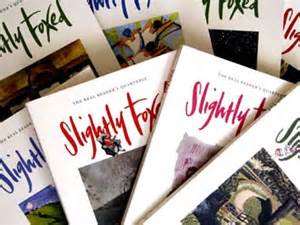
 Slightly Foxed, the self-proclaimed “Real Reader’s Quarterly,” explains its name in the editors’ notes of the very first volume: Spring, 2004. It seems that foxed is a term most often bandied about by literary antiquarians, used to describe books whose pages have become spotty with age (as opposed to being spotted by the hot caffeinated beverage I was drinking that day). It may or may not be a more commonly British term. I’m familiar with the prospect of dog-eared volumes (though those people that do so intentionally apall me), but this descriptor is a new one to me.
The idea is the same. I love my books, and I try to take care of them (as much as my own clumsiness will allow), but ultimately, it’s about the words within the pages. I’m not adverse to a bundle of papers, held loosely together by masking tape, taking a place on the shelf next to my pristine hard copies, if the story has earned it. You might say it gives my collection character. The people at Slightly Foxed would say so, at least.
This quarterly isn’t exactly a review magazine, as its mission statement is somewhat different. Rather than covering the latest literary publications, analyzing them, and giving us some summation and judgment on whether to read them, the staff prefers to tell us about their favourites, both new and old, classic and obscure. Each review is written by some contributor who really, really thinks that we should read this thing. Additionally, most of the review subjects selected are done so for the very good reason that we are likely not to have read them.
I’m already a bit behind in my reading as it stands now, but each seasonal volume of this delightful collection has discussed at least a few books that I’ve decided I really must find time for. As I haven’t actually been able to read any of the choices in question yet, I can’t say for sure that the foxy suggestions will always be right, but these reviews are thorough, and the reviewers do seem to know what they are talking about. (You can fake that, of course. For example, I have a collection of dictionary pages stuck to my walls, and I throw darts at them randomly to help “class up” my sentences at appropriate intervals. My dissimulation is impermeable!)
No, seriously, these are lovers of literature, as are all of us here at Green Man, as are, presumably, you, dear readers. I greatly enjoy receiving good recommendations from fellow bibliophiles, and I don’t think I need hesitate in recommending that you consider these recommenders for your recommending needs (not forgetting about us, of course).
But in fact, there’s more to this quarterly than just recommendations. There is a personal touch to each review (which I continue to refer to these as, for lack of a better word, though some border on mini-essays; others, historical expositions; yet more, lavish monologues), which I enjoy. Oftentimes, as much time is spent discussing the author’s personal connection to the literary work in question as the literary work itself. The magazine itself has literary value, beyond the discussion of already existing works.
I haven’t mentioned the format of the thing. It’s standard digest size, paperback, but bound in something thicker than the usual fare; the finish is matte, not glossy; and the entire thing is full of the most charming engravings. There are at least half as many illustrations in each volume of Slightly Foxed as there are reviews, at a conservative estimate, and they are just so wonderful, really. Much like the reviews themselves, which don’t know exactly what they want to be, this magazine strives to be something more. These volumes are beautifully classic hardcovers, trapped in magazines’ bindings. They were made for book-ends. You don’t throw these out with your Vanity Fair and Cosmo; these babies get shelved (in the positive sense).
I got a year’s worth of these all at once, but Slightly Foxed seems like a great thing to have a subscription to. You leave the latest copy on your coffee table, and read for 10 or 15 minutes whenever the mood strikes you. As you discover, or rather, as the contributors within share with you their discoveries, you make note of those described gems that really resonate with you, and you make it your mission to track them down, even if they’ve been out of print for 30 years (there’s usually some good advice on how and where to track down some of those more difficult to find). A quarterly publication seems just about right, so that you don’t feel inundated with “to read” memos, but will never lack for good ideas, if you’re not the sort to overload yourself with reading materials to begin with. So, if you’re looking to explore some lesser-known works that have fallen through the cracks, this might be a good place to start.
(Slightly Foxed Limited, 2004)
Editorial note: Yes it’s still an ongoing endeavour today!
