
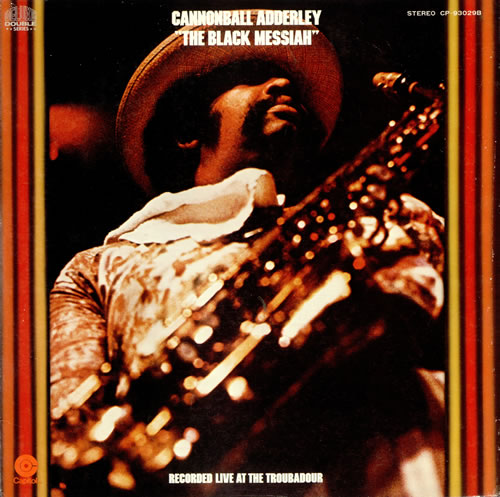
 Three and forty years after it was recorded, this amazing set of live jazz by the Cannonball Adderley Quintet is seeing its first release on CD. It’s a revealing snapshot of where jazz and especially Adderley were in those heady early years of fusion.
This double CD set is designed to resemble the original double green-label album from Capitol, containing selections from a series of dates recorded at The Troubadour in West Hollywood August 3-9, 1971, edited together into what appears to be a continuous live set, one of two played each of those evenings.
Adderley, having been in the forefront of soul jazz in the late ’60s, was further questing for meaningful explorations of the fusion of jazz, rock, soul and avant garde in the last few years before his untimely death in 1975 at age 46. For one thing, he had recently started playing soprano, which he does on a couple of numbers here, with and without effects. In addition to regular quintet members Nat Adderley on cornet, Roy McCurdy on drums, Walter Booker on bass and George Duke on keyboard (mostly electric Wurlitzer), on this outing they were joined on all pieces by Airto Moreira on percussion, and by versatile session guitarist Mike Deasy and Ernie Watts on clarinet or tenor sax on many, plus appearances by Alvin Battiste on clarinet and Buck Clark on “African” percussion. As Cannonball says in one of his signature between-song raps, “Now, I don’t give a damn whether you can count or not; we still are the Cannonball Adderley Quintet!”
The Adderleys never let themselves be defined by the music of the moment or put in a box. So although, as this set documents, they were playing fusion, soul jazz, rock, Chicago blues and straight-ahead jazz, Cannonball never makes a point of labeling anything as such. It’s all just the music to him.
And what music! It’s definitely of its time, so you get some fusion elements, especially in the longer workouts, the 16-minute title track and the 15-minute tribute to Herbie Hancock “Dr. Honouris Causa.” George Duke, fresh from a stint in Frank Zappa’s first post-Mothers band, puts his electric piano through its paces, playing it through wah-wah and other effects pedals in much the same way that Chick Corea was doing in Miles Davis’s band at the time. Deasy brings the rock on his country blues “Little Banty Hen” and the electric blues on the amazing “Zanek.” Brazilian and African percussion plays a big role in many of these tracks; Moreira has a nearly unaccompanied untitled solo on the second disc, and both he and Clark are a major part of the soundscape that makes “The Chocolate Nuisance” such an effective bit of avant-jazz.
But Cannonball and Nat really shine here. Cannon’s soulful lines ground “Black Messiah” firmly in post-bop with some soul elements, and he’s amazing on the soprano on “Dr. Honouris Causa.” The tight unison and close-harmony notes he and Nat play on this one are spine-tingling. Not everything sounds as fresh as it did 40 years ago, particularly Nat’s experiments with moaning and growling through his trumpet while he was playing it, or his vocals on the Ellington song “Heritage.”
This record of the superb music being made by Adderley and his group is a testament to the ferment that was taking pace in the space where rock, jazz and avant-garde music mingled in the early 1970s. And it only further highlights the tragedy of Cannonball’s early death. Great original production by David Axelrod, and top-notch reissue liner notes by Bill Kopp. Class package all around!
(Capitol, 1972; Real Gone/Blue Note, 2014)
