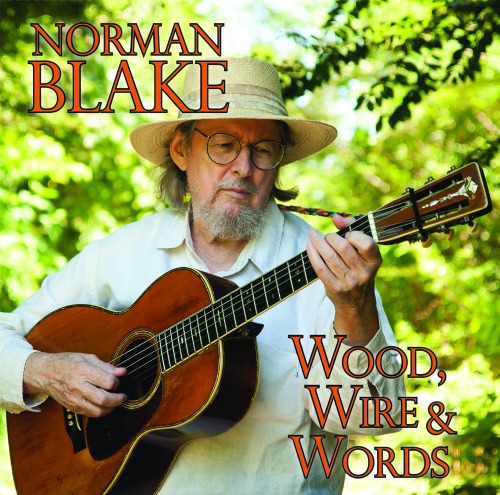
 Any time Norman Blake puts out a record is an occasion for joy. The release of Wood, Wire & Words is especially notable, being his first album of all-original songs and tunes in 30 years. And what songs they are!
But first a little introduction, in case you’re not familiar with Norman Blake. Both solo and with his wife Nancy Blake, he has been involved in American roots music since long before it was called that. Just to hit the high points: He was the guitarist in the house band on Johnny Cash’s televised variety show in 1969; he played on the Nitty Gritty Dirt Band’s seminal, multi-generational album Will The Circle Be Unbroken, Bob Dylan’s countrified Nashville Skyline album, and John Hartford’s Aero-Plain LP; and he’s been on the soundtracks of numerous influential films including O Brother, Where Art Thou? all while making dozens of his own recordings.
Born in Tennessee and now based in rural Georgia, Blake just keeps doing what he does, which is write, play and sing authentic American music. On this album he has reached back to a century ago when ragtime was all the rage, and concocted several jaunty instrumental ragtime pieces for solo guitar. The album opens with “Savannah Rag” for his current home state, has “Blake’s Rag” placed right in the middle, progresses on to “Chattanooga Rag” for his birthplace, and ends with a stately, ante-diluvian march called “Cloverdale Plantation” after a richly historical Virginia farm. There’s your tour of the deep south right there!
Those instrumentals punctuate the eight songs here, six ballads and a couple of spiritual-type numbers. All of them Blake sings alone in his warm, slightly raspy voice that’s just as solid and real as the land, except for the stately country gospel hymn “There’s A One Way Road To Glory” that he sings as a duet with Nancy. They harmonize so amazingly well together! This song sounds at first like a regular Baptist-type hymn, with its list of do’s and don’ts for getting along in the world and getting to heaven, but it’s something a little more global than that. Those do’s and don’ts apply at the personal, yes, but also the corporate and national levels, and all point toward the purpose of “putting an end to war,” but still in the plain, straightforward language of country gospel. It’s a blending of conservative and progressive that is so rare in this country today.
The other rather spiritual number is “The New Dawning Day” and it comes right before that duet. This beautifully fingerpicked tune is reminiscent of Elizabeth Cotton at times, and I find its sweetly down-to-earth sentiments quite moving, gently dealing as it does with mortality: “When we step through the veil / and gaze back the other way / we shall ride the golden sunbeam / of our own new dawning day,” Blake sings in a late verse.
The ballads are so plainly delivered that it’s easy to miss how deceptively solid and artful they are. They all tell interesting stories of what appear to be real people and happenings, from the death of a stationmaster named Audley Condra in a train robbery in 1925; to the piquant tale of a man and his wife who know that they’re fixed for life because they get paid $15 a month “for keeping the government light on the river”; to the hanging death of one Joseph Thompson Hare, hanged for a life of crime after being run to ground on the Old Natchez Trace; a slyly humorous tale of the Old West robber Black Bart; and a lament for Francisco Madero, a President of Mexico who was assassinated 100 years ago during the Revolution. Last but not least is the clear-eyed but nostalgic portrait of an old Georgia general store back when gas was 19 cents a gallon.
Blake’s beautiful guitar tone and voice equally anchor all of these songs, which are recorded in a way that lets their stark beauty stand out. This record was obviously lovingly made by Blake and the folks at Plectrafone Records. You can learn more about it and order it and lots more Norman and Nancy Blake recordings at their website. (Do be careful if you do an online search for Wood, Wire & Words because that’s also the name of a bluegrass group from the U.K.)
(Plectrafone, 2015)
