
 Andrea S. Garrett wrote this review for Folk Tales.
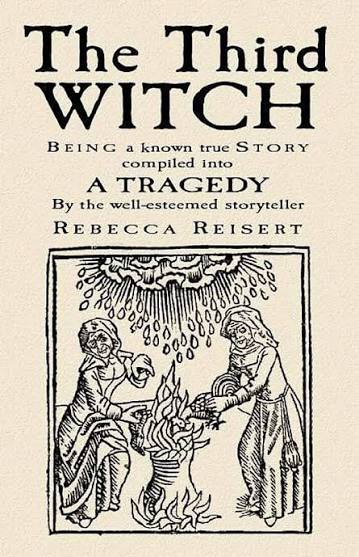
Rebecca Reisert’s novel The Third Witch is a re-telling of the “Macbeth” story from the point of view of one of the witches. They are Gillyflower, our heroine; Nettle, middle aged, skinny, rock of the family; and Mad Helga, the oldest, bald and scabrous and per her name slipping in and out of sanity. In the first few pages we learn that Gilly is not only caught up in the tumultuous emotions of most 15 year olds, but she passionately desires revenge against “Him.” Of course those of us (everybody) who are familiar with the Macbeth story pretty much guess the identity of “Him.” Like a typical teen Gilly views the world in black and white — she seeks revenge against Macbeth and she refuses consider anything else, though her vengeance may destroy her little family.
Gilly has obviously come from a life very different from the one she now leads. As the story unfolds we learn more about the terrible events that culminated in Gilly’s being cast adrift as a child to be found by Nettle and Mad Helga. And Gilly begins to discover that the world is made of such gray shades that her decisions become more and more difficult.
Reisert brings the world of these impoverished women in 11th century Scotland to dirty, hungry life. As the story begins the three set out to glean — but from a battlefield rather than a wheat field — hoping to find useful or saleable items among the stiffening dead. The pragmatism a 15 year old is able to muster in order to search dead men for goods is an effective touch. Gilly has been fostered by two women who have almost nothing; they teach her the herbal medicine and lore which is their main method of eking out a living. It is a dangerous way of life, however, since those who live outside society in this way may be accused of witchcraft and hung or burned. Reisert makes real the torn clothing and dirt of the three women who look like “the wild heart of the wood” and live in the forest where the villagers fear to go. Yet the kindness and loyalty of Nettle and Mad Helga, who have formed a family and taken in a stray child, are also apparent.
Gilly nags Nettle constantly to fulfill a promise apparently made years ago when she was a foundling and cast a spell to destroy “Him.” Nettle naturally refuses, pointing out their poverty and helplessness. Gilly persists even when Mad Helga tells her “…doom is costly.” and Nettle’s second sight reveals that harming “Him” “will bring death to our very door.” The reader realizes that the older women do possess magic of a sort, though it’s not always controllable or performed without a price.
With the callowness of the young, Gilly refuses to consider this price; she sets off for Macbeth’s castle. On the way she most reluctantly acquires a young boy, “Pod.” I don’t want to reveal too much but I found this sequence of events to be the most evocative of just how brutish and violent life could be, especially for the poor, in this time and place.
Gilly disguises herself as a boy and acquires a place for her and Pod in Macbeth’s kitchen, ruled by a lascivious cook. It seems as if her quest is about to be completed, but Gilly’s choices become more and more difficult. Will she be able to kill a seasoned armed warrior? How willing is she to abandon the simple Pod? What if innocents are killed because of her desire for revenge?
I thought the “double double toil and trouble” scene — closely based on Shakespeare’s play — was very well done. Gilly has reunited with Nettle and Mad Helga. The three witches are led by Nettle’s second sight to a misty cross roads where Macbeth will pass. Nettle uses her magic to set Macbeth on the road of destruction, but this will also inevitably lead to the destruction of many others. She offers Gilly yet another chance to turn from this path. Gilly refuses, and Macbeth and all whose lives he touches, both innocent and guilty, are cannoned off the power of the witches’ prophesies. The scene is portentous and filled with atmosphere without being overdone. The reader knows the things Macbeth believes he is hearing will be cruelly twisted. Just so we can imagine Gilly’s revenge going awry.
This is a well-written book and a fun read. The fact that I was familiar with the storyline didn’t quell my interest any more than it would have Shakespeare’s audience in the time of the Bard himself. The play is fleshed out with some interesting twists and turns — Reisert uses her obviously fertile imagination and knowledge of the period to fill in some of the gaps that perhaps many of us have wondered about. That being said, Reisert is not a poetic writer or a spectacularly gifted one. You won’t be carried away by her prose or her ability to insert you into the action. This is not a page-turner and the ending is a little forced. This is not to say the book is dull or not worth reading; it is well-crafted with an interesting story and characters you come to care about. Perhaps it is more interesting because you know the bare bones of the story and it’s fun to see what Reisert does with it.
The dust jacket tells us that Reisert has written over thirty plays and has taught high school for twenty-six years. This is apparent in just how believable a teenager her Gillyflower is. This is her first novel and I hope we’ll be seeing many more.
(Washington Square Press, 2001)
