
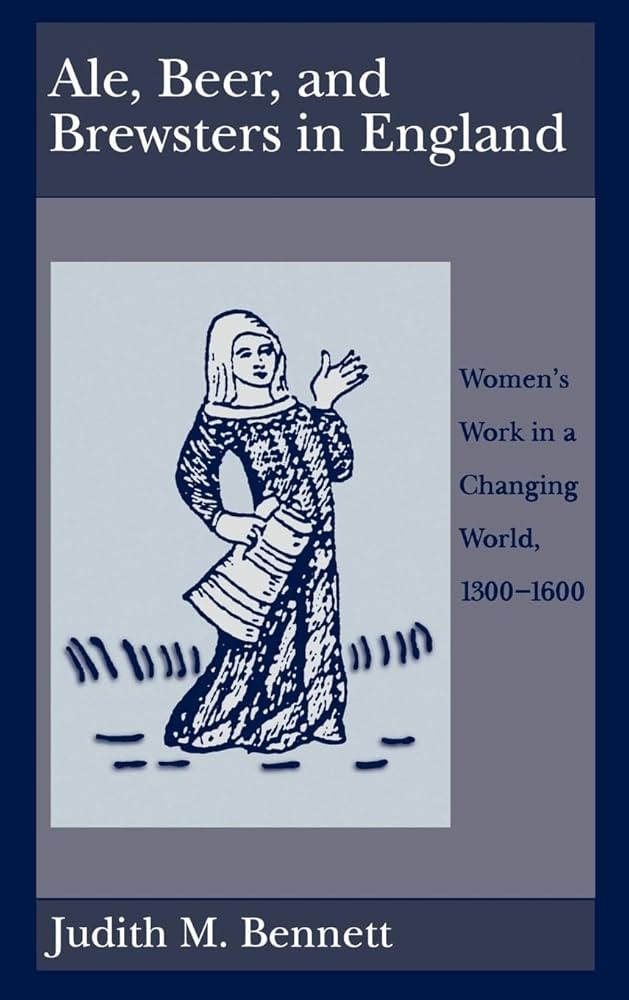
 It is not a commonly known fact that in the 14th century in England most beer and ale brewed for sale was brewed by women. Three hundred years later it was an industry run by men. One of the changes that brought this about was that brewing turned from being a cottage industry, where people brewed for selling to the local community at the same time as brewing for their own needs, to a big-scale industry, with the goods being transported over longer distances before being sold. So the wife brewing to supplement the income of the household lost her business to men managing bigger scale operations.
The first change came after the Black Death in the middle of the 14th century. Until then there were few women, or men, who brewed professionally. Instead you sold parts of the ale you produced for your own household. After 1350 brewing started growing as a profession, one of the reasons being that consumption of ale increased, partly because an improved diet made people drink more of the beverage.
Over about 150 pages, not counting appendices and notes on sources, Judith M. Bennett traces this development in her book, sub-titled “Women’s Work in a Changing World, 1300-1600.” The book is clearly aimed at the history student and anyone very interested in the subject. It is more the history of women’s relations with industry than the history of beer and ale. Bennett goes into great detail concerning changing laws and records of individual brewsters. Forty pages of notes on sources and a bibliography of fourteen pages show how ambitiously she has treated the subjects.
There was a special word for females who brewed beer for commercial purposes. They were called brewsters, as opposed to males with the same occupation who were and are called brewers. The importance of the brewsters is shown in the fact that the magistrates in England who supervise the trade in alcoholic beverages are still called “brewster sessions,” a remnant of the old days when the permits were mostly given to women.
Maybe I am not the right person to judge a work of this kind; in spite of being a great lover of beer, though not someone with a very keen interest in the history of women (but do not tell my wife about that), I found it hard reading. I respect the approach of the book, being an academic work, but I would love a more popularized version of it. A few bits really opened my eyes and enriched my knowledge of the Middle Ages, but I would only recommend this book for academic studies in history.
(Oxford University Press, 1996)
