
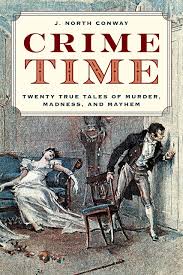
 J. North Conway’s Crime Time: Twenty True Tales of Murder, Madness, and Mayhem is a nice little volume taking a quick peek into a number of cases that, with or without a conviction, have both an interesting course of events and an interesting outcome.
Each chapter features, before the text proper, a contemporary illustration or photograph to help illustrate the crime. It is a good choice, an easy way to humanize those involved in the crimes, and pull them closer to a present reality for the reader. In addition each section ends with a contemporary bit of prose, detailing the people in question, in their own words. This again elevates a summary to something more personal in the mind of the reader, serving as a very specific type of bookend.
An interesting aspect of the crimes in this volume includes the fact that multiple cases (chapters 5 and 8) feature abortion (actual or potential) as a factor, usually due to the difficulty in procuring one. Indeed the entirety of the case in chapter 8 hinges upon an abortionist and the details of the law surrounding him. Given the stories in this collection mostly span the eighteenth and nineteenth centuries, it is an interesting curiosity if it is not a deliberate sociological point could bring the matter up in such a fashion. This is in no small part due to the fact that, unlike most other recurring elements, such as theft and poisoning, abortion wasn’t always a crime even in this era.
By similar token vigilante and non-traditional attempts to gain vengeance or justice appear a number of times. These include posses of angry men, buzzare legal arguments to ensure additional trials, and one of America’s first suits for what amounted to malicious prosecution. These little details are often more interesting than the crimes themselves and will keep a reader interested longer than simple statements of the facts of the crime alone might.
The types of crimes are varied. With theft, kidnapping, murder, blackmail, and gang violence being some of the more obvious examples. The discovery of bodies is described in some, while in others the actual sequence of events for the crime is detailed. Each example is well explained, getting a few good details into a general summary.
Still, definite imperfections exist, particularly in the area of vague or difficult to understand details. On page 70 an illustration is featured in such a way that readers will be unsure if it represents John Webster or George Parkman. By the same token the chapter 5 mention of abortion is completely absent from the the index, as are all mentions outside chapter 8. Poison has no entry in the index at all, in spite of Chapter 9 flat out being titled “Prince of Poisoners” and the subject coming up repeatedly elsewhere. Overall, while the index is appreciated contextually, so much is missing that it is almost useless.
J. North Conway is a well-known author with a number of very successful books under his belt. This particular volume reads more like a collection of shorts rather than a single narrative, yet is none the less entertaining for that fact.
(Lyons Press, 2021)
