
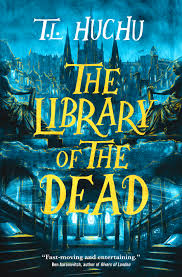
The Library of The Dead by T.L. Huchu is an interesting piece of urban fantasy which shows quite a mix of elements. It is also his first novel, and is intended to start a series. The book as a standalone is an interesting artifact, opening with evocative imagery.
Green dreadlocks are mentioned quite early on, and it is enough to make many readers shunt this particilar fantasy as something closer to a shonen anime in terms of style. This would not be accurate, nor a complaint. Still, that stylistic decision, and the negative reaction to it by certain traditionalist characters, will help the reader to be on their toes.
The more or less modern setting, young (14 years old) protagonist, bright colors and musical theming lend further to the comparisons to japaanese action cartoons. The actively and severely dystopian use of police to the point of blatant and obvious theft tells the reader this learns more and more towards the punk aesthetic and style.
By the end of chapter 3 the lead here, Ropa, has ignored a missing child and given negative opinions of virtually everyone and thing. The parallels to early cyberpunk might hit the reader again as some level of unlikability was common on such leads. Even so to open a book and have the hair and fact she likes certain types of podcasts be the only positives regarding a character is much to ask much of the reader. Some chapters where she is tender to her grandmother helps, but the introduction of a hairy big nosed greedy human being lends to probably unintentional antisemitic steriotypes, and using conservation as an excuse to kill small animals (having also planned to capture, fatten and kill a fox), leaves the reader still confused. Still, they paint vivid imagery, and one hardly notices that it is chapter 6 before the library is brought up in a way that suffers attention.
Still, the author wisely drops the reader directly into the action, with our lead meeting some aristocratic individuals who are having a particular set of problems dealing with the supernatural. They are judgemental and somewhat thoughtless, stepping away to say something but not enough so that it has any real impact on our lead (the subject of the conversation) hearing. The problem itself is simply handled, and that nicely helps the reader learn about the skills the narrator possesses. Further, later in the book clear examples are given for the jaded attitude towards communicating with the dead, yet by this time the reader has developed annoyance at the lead for the previous hateful actions towards one with a missing child.
There are moments of clever worldbuilding. The Library of the title being a hidden organization is delightful, and the way to get there similarly so. The supernatural entities are clearly thought out, and a third of the way into the book the magic system is explained, as the narrator sums up a book on the subject. Quite a nice way to handle the matter, and allows the reader to see her gaining enjoyment from a book. The little details about respecting the King come up time and again, finally antimonarchist as they describe such respects as a fact of life.
At the same time, the status of the lead as broke and squatting, in spite of a number of lucrative clients and the obvious ability to get more, is not sufficiently explained. A little touch of bureaucracy references this, yet it has no real job at explaining it. The Librarians are depicted as hateful, elitist, and villainous, something strange from an otherwise left leaning volume.
One wonders how any reader would react to the line about official audiobook readers as nothing more than “plodding through” the pages “cause they never got that big break in the soaps.” (page 43) would it be seen as an attitude of the narrator or the author?
Overall The Library of the Dead is an interesting look into a new and interesting world. It features a nice mystery and clever characters. The biggest weakness is the lead, a narrator the reader will likely less than enjoy to start, but such is often the way with teenagers. An enjoyable book, with potential in future volumes for greater interest.
