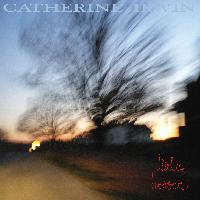
 Catherine Irwin has one of those singing voices that, for some people, takes some getting used to. Tom Waits, Bob Dylan, Joni Mitchell and many more fall into this category. In most cases, it’s worth the effort. For me, Irwin was never a problem. Her vocal style is cracked, worn and mournful, suited to singing old, wise and sad songs that originated in some dark holler. Which is exactly the kind of music she makes, so the tool is right for the job.
Irwin and Janet Bean started Freakwater, one of the earliest bands making what would come to be known as alt-country music, and the two released their first album in 1989. They’ve continued to make authentic country music with a punk aesthetic and attitude, turning out a total of seven full-length albums, plus some solo projects for each. Little Heater is Irwin’s second solo, and the first we’ve heard from her since Freakwater’s 2005 album Thinking Of You. If you’ve been looking for the perfect album for sitting on the porch (front or back, makes no mind) of an evening with some sipping whiskey and contemplating the turning of the seasons, look no more. Little Heater is spare, elegant and graceful, a little funny but mostly sad or at least contemplative.
Irwin has many strengths, and she plays to all of them. She’s an exceptional songwriter, she knows how to choose a good cover song, and she employs that voice to pull the listener into the song and feel what she feels. On Little Heater she has also assembled a fine cast of supporting musicians, and they don’t let her down.
I could write a longer review than anyone would want to read just about the songwriting. Give a listen to “Mockingbird,”particularly the second verse, about 1:35 into the song, and pay heed to the intricate rhyming scheme and ragged meter: “Balling in some places / is bound to cause a scene / Falling in some cases may portend / the end of a dream. /It’s appalling this endless scrawling / on the lines and in between ./ It seems like the meaning is leaning / towards busting at the seams.”
That uneven meter, where one line goes on longer than you expect it to, or the next line starts sooner than you expect, is typical of the kind of Appalachian music that is Irwin’s chief idiom. (Note the album closer, the traditional “Banks Of The Ohio.”) Just go back and listen to some of the original Carter Family recordings such as “Keep On The Sunny Side” to see what I mean. And many songwriters try to do it but few modern ones succeed – listen to John Lennon’s early demos of “Across the Universe,” for instance. There’s a reason he smoothed it out in the version that was released. But Irwin uses it to great effect in several of the songs here. One of her typical tricks is to slip into a quick two-beat measure of triplets in the middle of a waltz like “Mockingbird.”
Irwin is not afraid to use humor, often bawdy or sarcastic, as in that verse of “Mockingbird.” There is less of that here than on some Freakwater albums. Mostly what I notice is the quick turn of phrase and unexpected word choice, the mad rhyme schemes augmented by the side-slipping meter. The sarcasm is more often biting, as in the debutant-from-hell song “Hoopskirt” or the romantic revenge number “To Break Your Heart.” There’s some social commentary, in the likes of James Jackson Toth’s “We Must Also Love The Thieves” and Irwin’s coal-mining song “Flowers Of Darkness,” and allegorical love songs such as Brett Eugene Ralph’s “The Whole Of The Law” and Irwin’s “Nightshade” and “Save Our Ship.” And some harrowing mountain balladry, particularly “Piss To Gin,” in which she sings, over a sparsely plucked banjo and scratching violin, lines like these: “Standing on the corner / of hell and high water / X’s for your eyes and sugar for your tea / neck stuck out like a lamb to the slaughter / Baby come along with me …” One of my favorites is the sad country ballad “Sinner Saves A Saint,” written by the late artist John Callahan.
The arrangements are one key to the way these songs work, whether it’s the stripped-down Appalachian sound of “Piss To Gin” or the gentle doo-wop of “Hoopskirt” with the backing singers doing little “oo-oos” behind lines like “Oh the eardrums hum / and the eyes like saucers shine / the note you held and cast aside was mine …”, or the moaning pedal steel in “To Break Your Heart” and “Sinner Saves A Saint.”
Marc Orleans plays that pedal steel and deserves much recognition, as does Tara Jane O’Neil, who produced, played lots of instruments and sings on several songs. Other singers include Elizabeth Mitchell and Bonnie “Prince” Billy (that’s him on “Mockingbird” and Jean Cook, who also plays violin and arranged the strings, particularly on the beautiful “Save Our Ship.”
Little Heater is modern hillbilly music, and to me that’s a high compliment. It starts with ancient mountain music, its gothic themes of love and betrayal and redemption, its basic instrumentation and no-nonsense singing style, and wraps it in a post-punk attitude that has been Irwin’s hallmark from the beginning. Highly recommended.
(Thrill Jockey, 2012)
