
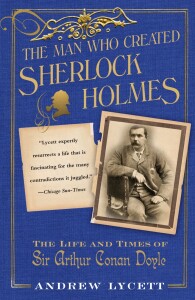
 Faith J. Cormier penned this review.
First, he chose an interesting subject. Arthur Conan Doyle may have died in 1930, but his most famous creation, Sherlock Holmes, seems immortal. He was a complex man — author, sportsman, military historian, physician, lover, spiritualist seeker — who would have been fascinating even if he had not decided to write anything about Holmes at all.
Second, Lycett has obviously done his research. The advance copy I read didn’t have his notes and bibliography, but the number of quotes in the text, as well as the references to letters, bank records and other documents even when they are not explicitly quoted, show that he used a multitude of primary sources. For instance, in an article in The Guardian, Lycett refers to an important collection that had been kept under wraps by the Doyle family for about 70 years and then became available in 2004.
Third, the tone is respectful without being adulatory. Lycett makes it clear that he disapproves of Arthur Conan Doyle’s behaviour in several respects, notably the fact that he began a relationship with his second wife before his first wife’s death, his estrangement from his two children by his first marriage and his credulity with respect to spiritualism. On the other hand, he doesn’t muckrake around looking for titillating details (and surely there must be some available somewhere). Conan Doyle’s failings are not allowed to overshadow his many talents, nor his talents to excuse his failings.
Andrew Lycett puts Arthur Conan Doyle in context in The Man Who Created Sherlock Holmes: The Life and Times of Sir Arthur Conan Doyle, talking about his parents and grandparents and the circles they moved in so as to explain the milieu into which he was born and the influences on his childhood. The advance copy has spaces for family trees and I’m sorry not to have had the benefit of them. Both sides of Conan Doyle’s family had a lot of interesting people in them, and a family tree would certainly make them easier to keep track of.
All in all, this is a great read. It’s interesting and informative, and makes me want to find more of Andrew Lycett’s biographies. He has written about Muammar Gadaffi, Ian Fleming, Rudyard Kipling and Dylan Thomas.
If you want to know more about Sir Arthur Conan Doyle or Sherlock Holmes, there are vast numbers of sources. You could do much worse than to start here with the Web site of Conan Doyle’s literary estate. Very brief information about Andrew Lycett can be found here.
(Free Press, 2007)
