
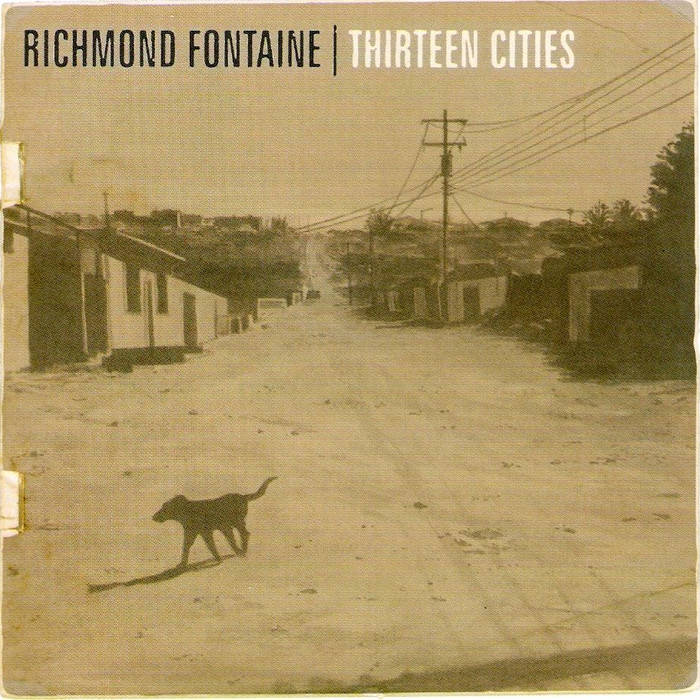
 The Portland, Oregon, band Richmond Fontaine makes a distinctive brand of alt-country noir music. With Thirteen Cities (their eighth studio release in addition to two live albums) they’ve teamed up with a bunch of Tucson, Arizona, regulars to produce a song cycle set in the loneliest reaches of the modern American West. It’s as though Ray Chandler and William Kittredge teamed up to write an album’s worth of songs on Western alienation and anomie.
Frontman Willy Vlautin, a Reno, Nevada native, writes all the songs for Richmond Fontaine, and sings them too. He’s also a published author of noir fiction; his 2007 novel The Motel Life received strong reviews in the regional and national press.
Vlautin’s songs are often short stories in themselves, and that’s definitely true of the songs on Thirteen Cities. And with the backing of members of Giant Sand and Calexico, as well as instrumental and production work from Nick Luca and Craig Schumacher, and production by JD Foster, these tales have a lonesome, dusty verisimilitude. The map on the inside cover of the CD booklet pinpoints the titular cities, all of which are mentioned or alluded to in the lyrics.
After an atmospheric instrumental introductory track called “Intro/The Border,” the band launches into the mariachi-rock of “Moving Back Home #2,” in which we find the protagonist comtemplating suicide by jumping off a parking structure. “I’m living in my mom’s basement again / I come in at 4 a.m. / She gets pissed, got to be up at 6 / We get into a fight so I go out again,” Vlautin sings in his cracked tenor. “What, oh what, oh what the hell was I thinking?” is the catchy refrain.
Just about every song is another sharp exercise in short story-telling. The titles are highly evocative, too. “$87 and a guilty conscience that gets worse the longer I go” is a near-stream-of-consciousness narrative in which the protagonist details his silent complicity in the misdeeds of his friend as they travel from Albuquerque to Las Cruces to Yuma and Mojave, where he finally turns him in for statutory rape. In “I fell into painting houses in Phoenix, Arizona,” the young workman watches his own life fall apart after he quits a job because the boss cheated a young illegal alien of his wages. He ends up working as a janitor at a racetrack — one of Vlautin’s favorite hangouts — but he can’t seem to leave his dead-end life: “To watch a horse break down or your girlfriend who can’t stand the sight of her own face, or to watch your sister drink her life away / get me out of here …” he concludes.
In “St. Ides, parked cars, and other people’s homes,” he wonders why the plans for a normal life he and his girlfriend had came to nothing. “There’s thousands and thousands of houses here / People with families who go on vacations / Stick together year after year / Wasn’t that supposed to be me and you?” In “Capsized,” the listener gets to piece together a tale of crushing guilt that leads a man to always sabotage his own life: “But I will cut every tie that gets close to me / I’ll pay for my mistakes, I’ll pay for them you’ll see.”
Some songs are even more sketchy, and seem to just draw a picture of lonely spaces. “Westward Ho” consists mostly of the names of dingy motels. In “The Kid from Belmont Street” he tries to keep a young boy from trusting the wrong people. The character in “A Ghost I Became” starts dreaming of the desert, and eventually fades into the landscape as he moves farther and farther away from other people.
“The Disappearance of Ray Norton” is a spoken-word piece, with minimal backing from Calexico’s Joey Burns on bass and accordion. He tells of how a former friend became embittered when “Mexicans” began to take over their old neighborhood, and finally became a racist skinhead whose own family disowned him.
There is a brief ray of light. The indie-rock “Four Walls” is an anthem to slacker love: “We’ll just lay around and our hearts will sing like mariachis.” But that leads right to the final track, another short character sketch of someone who has lost all hope, reflected in the title, “Lost in This World.” Burns provides bare-bones piano and accordion backing.
Richmond Fontaine is a tightly functioning band, most of whose members have been together for years: Dan Eccles on guitars, Sean Oldham on drums and percussion and Dave Harding on electric and upright bass. Another mainstay is Paul Brainard, a fixture on the Portland music scene, who adds pedal steel, dobro and more. (You’ll find him on pedal steel on lots of other albums, including those by fellow Portlander M. Ward, who dedicated “Paul’s Song” to him.)
This band is much more popular and well known among Americana fans in Europe than they are in the U.S. You should help remedy that by buying this CD. Unlike all the characters in these songs, it’s a winner.
(El Cortez, 2007)
