
 Between 2007’s melancholy western geography lesson Thirteen Cities and this year’s Richmond Fontaine release, Willy Vlautin’s mother died, and he broke his arm and couldn’t play guitar for a while. When he healed enough to play, he went into a Portland, Oregon, shed and tried to write love songs. What he kept emerging with was melancholy short stories like “The Pull,” about a drunk who cleans himself up and takes up boxing, but after he turns pro has to quit because of injuries. Or “The Boyfriends,” the harrowing confession of a young man whose attempts at relationships are haunted by the ill treatment he and his mother endured from a succession of her unsavory boyfriends.
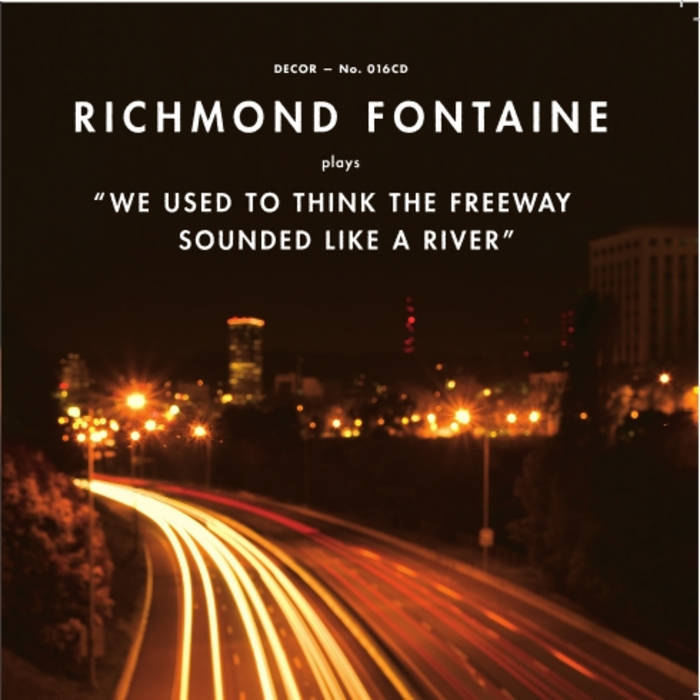
We Used to Think The Freeway Sounded Like A River is a lyrically raw and musically rich album, possibly the most mature and thematically unified record in Richmond Fontaine’s 15 years. Vlautin, the songwriter, singer and guitarist, has a couple of critically acclaimed noirish novels under his belt (and a third on the way in 2010), and his storytelling abilities keep getting stronger. Whether writing a novel-length tale or a four-minute song, Vlautin can deftly sketch a character and a scene in a few telling lines.
Vlautin’s perspective shifts from song to song, first to second to third person and back. And the songs frequently make sonic shifts of various kinds, too, stopping and restarting, speeding and slowing; they’re full of crescendos and decrescendos, jazzy offbeats and martial tattoos, mariachi horns, sighing organs and plaintive steel guitars. Always, though, they sound like Vlautin’s native American West, from the dusty desert backdrop of the title track to the spring rain-mimicking piano and trebly guitars of the brief instrumental “Northwest.”
The characters that people Vlautin’s songs mostly live on the fringes of society; those for whom the American Dream was never more than a remote possibility. They’re drifters and dopers and drunks. They’re losers – not necessarily the lovable kind – living with the consequences of bad environments, bad upbringing and bad choices, and mostly they’re blind to their own complicity in their condition, blaming others or just stumbling around in emptiness.
The music almost always echoes the mood. It’s particularly noticeable in “43,” a herky-jerky narrative of a guy entering middle age, facing all kinds of personal and financial pressures, who takes to “growing weed” to try to make some money. The music reflects the pressure that mounts with his isolation and paranoia, rising to a barely manageable pitch as he listens to the city’s sirens and helicopters and fears they’re coming for him.
On the title track, a ghostly saw haunts the lines between the melody and Vlautin’s quiet, almost spoken vocals. It’s a sad nostalgic memory of a couple living on the wrong side of town but being happy and making the best of things, until their home gets burgled and trashed.
In “Lonnie,” the narrator is talking to the title character, either in person or just in his mind, berating him for how badly he’s messing up his own life and those of the ones around him. “Ruby and Lou” follows two irresponsible young lovers who abandon their families but can’t find peace or contentment anywhere and just keep moving from place to place. In “Two Alone” another couple talks past each other, her accusing him of abandoning her, he just mumbling incoherently in return, as the music rises in pitch and volume around them. “You Can Move Back Here” finds the narrator pleading with a missing loved one to return from the big city to the small town, masking hopelessness with a pretense of hope. “Maybe We Were Both Born Blue” is the excuse one member of a couple gives for the emptiness both feel.
The whole album seems to be summed up in “Watch Out.” There’s a lovely melody sketched out on electric guitar, with only light accompaniment. The only lyric, which Vlautin repeats once, is “Watch out or your heart’ll be nothing but scars.” A female chorus echoes “watch out” a couple of times.
Richmond Fontaine is a highly intuitive band, as you’d expect after 15 years. They’re a joy to see perform, as a lot more European fans than Americans have discovered. The band’s sound is purely western, which seems to always be popular with a certain segment of the European music fan community, although less so right now in the U.S. The default sound seems to be languid, but when they rock they do so with authority, and always with lots of space in the sound. Everybody plays in an understated way: Dan Eccles on guitars, Dave Harding on bass and especially Sean Oldham, the criminally under-recognized drummer who both propels and holds together the band. This album has less of Paul Brainard’s pedal steel than some, and lots of Ralph Huntley’s piano. Another excellent release from Richmond Fontaine.
You can watch or listen to recent studio performances of some of these songs on the Oregon Public Broadcasting music Web site: http://opbmusic.org/performances/116-Richmond-Fontaine
(Arena Rock/Decor, 2009)
