
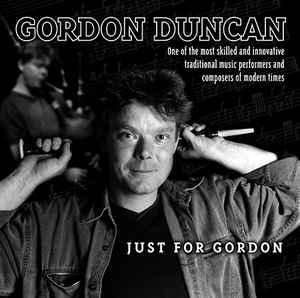
 Christopher Conder contributed this review.
It is regrettable that Just for Gordon marks the first time I have heard of Scottish bagpiper Gordon Duncan, because this compilation of largely unreleased work has been put out in tribute to the man, who died in the last month of 2005, aged just 41. It reveals him to have been a truly masterful piper.
With the exception of the closing track, each of these is a solo bagpipe performance, taken from a variety of competition performances, a radio session and an obscure cassette-only release. The recordings span from 1986 to 2001 and take in a number of styles, from nimble reels to Breton-style pieces plus stately Scottish airs and the intense, cascading A. M. Young composition ‘Thunderstruck’.
Duncan himself was quite the composer, too. The innovative ‘Andy Renwick’s Ferret’ and the poignant ‘Lament for the Coming of the White Settlers’ are two of the many included. The richest material comes from a 2001 session for BBC Radio Scotland that shows Duncan at his most virtuosic and inventive. The opening medley is a spectacular showcase for what an agile and dynamic instrument the pipes can be, far away from the cliché of ponderous, squalling airs by kilted men on bridges. A later set from the same session is just as impressive and features Allan MacDonald’s ‘The Handshaker’, a tune I know best from the playing of Martyn Bennett, another superb piper who died in the same year as Duncan.
There are plenty of highlights elsewhere as well. A medley of 11 (!) tunes from a piping competition in 1996 is enlivened by a distant percussive backbeat, which I like to think is Duncan stamping along in time. The earliest set, from 1986, is introduced by Radio Scotland presenter George MacIlwham, who highlights the great moment when the accompanying drones are stopped and then, half a minute later, revved back in again.
As with any solo instrumental recording, especially one as long as this at 77 minutes, you would have to be a real connoisseur to keep focussed throughout this album; and to the untrained ear some of tunes can sound samey. It is credit to Duncan’s musicianship, and Ian Green of Greentrax’s compiling, that the album is so successful despite these hurdles.
The final tune on the album, ‘Charlotte’, is a departure (which may explain why it is unnecessarily labelled as a bonus track) in that it is a slow, pretty instrumental duet with Dougie MacLean on fiddle and guitar and Duncan playing the low whistle. It demonstrates what is clear anyway – that Duncan was not just a piper but a well-rounded composer, interpreter, traditionalist, experimenter and musician. He may be gone but I believe his legacy will be long.
A good bio of Gordon Duncan can be found on his Wikipedia page. The Gordon Duncan Memorial Trust exists to ‘raise funds for the promotion of piping and other forms of traditional music amongst young people in Scotland.’
(Greentrax, 2007)
