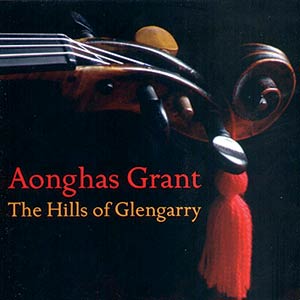
 Though born in Edinburgh, Aonghas Grant was brought up in Fort Augustus in the Scottish Highlands. He mastered the highland fiddle style as a boy, without lessons but by osmosis of the plentiful musical sounds that surrounded him. It is this natural process that provides the foundation of Grant’s truly organic sound. Grant went on to be a four-time winner of the fiddle championship at Scotland’s National Mod, and a much revered teacher of the fiddle to younger generations. Grant released his first album Highland Fiddle in 1977, but was to wait 30 years before recording The Hills Of Glengarry, the eagerly anticipated follow-up.
This absolute treasure of an album features 13 tracks of primarily traditional material alongside a few compositions by Grant and his contemporaries. Grant’s distinctive fiddle is augmented by a group of sympathetic musicians: Grant’s son, Angus R. Grant, himself an accomplished fiddler with the band Shooglenifty; the rich and resonant cello of Canadian Christine Hanson; the nimble guitar work of Ross Martin; and the animated concertina of Paul Connelly.
Right from the opening set of tunes, “Glengarry’s Gathering / Glengarry’s Dirk / Lochgarryside Reel,” Grant’s fiddle playing brings a raw style to tunes that might otherwise appear relatively formal – it is this aspect of Grant’s interpretations that makes the tunes instantly accessible and utterly enjoyable. “The Earl of Jura” is a sumptuous slow air that showcases the sensitivity that Grant can instill in a tune, played with such tenderness it almost sounds like Grant’s fiddle is weeping. Adding a genuine personal touch, Grant gives a spoken introduction to the tune “Di Molaidh an Uisge Bheatha” (In Dispraise of Whiskey), explaining the story behind the tune, and in doing so, bolstering his reputation as a teller of great stories! It’s a pity this wasn’t extended throughout the album – having recently seen Grant performing live myself, my memories are of an evening of great stories, just as much as of great tunes.
The album closes fittingly with the stirring traditional air “The Parting Glass,” a tune that has provided the fond farewell of many a session. Through Grant’s evocative portrayal is imparted the sorrow and yearning that accompanies such a parting – you won’t need the title of the tune to understand that.
With The Hills Of Glengarry Grant surely cements his position as one of Scotland’s most precious musical treasures, though for those of us making a wondrous discovery, he could just as easily be viewed as one of Scotland’s best kept secrets.
(Shoogle Records, 2007)
