
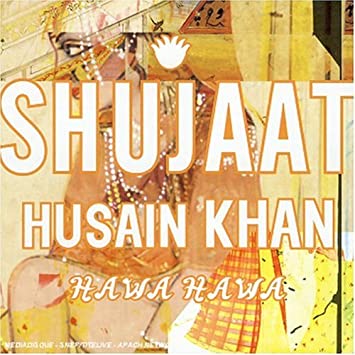
 This review was contributed by Big Earl Sellar.
This is one of those discs that I go into thinking, “Oooh, this is going to be cool.” I hate it when I do that: a premise is hardly the basis of fantastic music. On this disc, Indian sitarist and singer Khan recalls six songs from his rural youth, folk melodies from days gone by, and interprets them using only himself and two percussionists. Like I said, great premise: a master of a classical idiom tackling the sparsest, simplest, and most rudimentary of the musical forms, the true folk tradition. But Hawa Hawa doesn’t quite live up to expectations, unfortunately.
It’s really a good disc, featuring superb playing. Khan is an extremely lyrical player, facile in his blends, slowly glissing around the sitar where showier players would hit us with a barrage of flurried notes. On “Mitti da Bawa,” he accents little slurs in his approach, subtly adding inflections to flavour the music. The percussion is bang on, bereft of the fills that most tabla artists let loose every other beat. It’s a much more gentle disc than many I’ve heard in this tradition lately, and overall, it’s a pleasant little listen.
But it’s not very interesting. Not counting the lack of virtuoso sideshows overpowering the songs, Hawa Hawa is virtually interchangeable with any other disc out there featuring the same vocal-sitar-percussion format. Khan is an able player, but he is not breaking any new ground. I suppose it’s the same in any classical tradition: rather like European and Chinese musicians, the expectations of the tradition creates a certain sameness to the playing. Khan is also drowned out by the percussion on this disc, which is way too upfront in the mix. Indeed, his voice is drowned out in whole sections, which, given that he’s a fairly plaintive singer, is not necessarily a bad thing.
The real shame is that I couldn’t really hear anything particularly rural about this disc. Get the London Philharmonic to tackle the English tradition, and you’d get the same thing: something that sounds radically different from what it’s supposed to be. And given that Khan comes from a long line of master classical sitarists, this isn’t surprising. I mean, I don’t hear the music on this disc the same way that someone who grew up listening to this stuff would. Likewise, Khan’s long classical background overpowers any notion of “the essence or soul of a country or region,” as the liner notes state. Take a classically trained violinist and get her to play “Turkey In The Straw,” and the same thing is bound to happen.
Hawa Hawa is a very listenable disc, but not very exhilarating to me. There are much more fascinating discs out there, ones that transcend the aural wallpaper that this disc lapses into at times. It’s a nice addition to anyone’s collection of Indian classical music, but don’t think for a second that it belongs with your folk discs. Rats…
(World Village, 2003) https://www.facebook.com/worldvillagefrance/
