
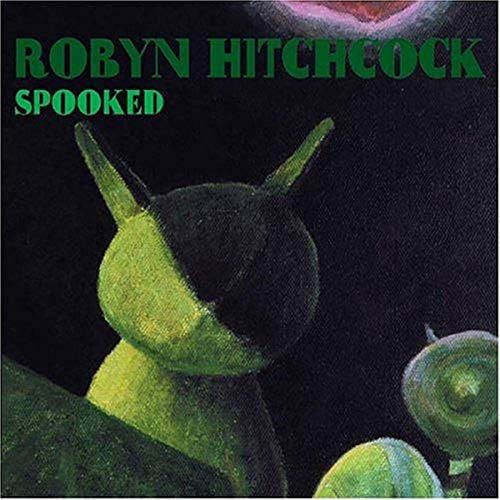
 Here’s one that nobody saw coming. English psychedelic folkie Robyn Hitchcock’s latest album is a collaboration with American alt-oldtime darlings Gillian Welch and David Rawlings. Hitchcock, who has been making his own idiosyncratic brand of music since 1977, when he founded the Soft Boys, met the much younger American duo in 2004 while he was in the U.S. for the filming of the remake of The Manchurian Candidate, in which he has a role. The three, discovering a respect for each other’s work, got together for a jam session, followed by an intense two weeks in Welch & Rawlings’ Nashville studio making this record.
A fan of Welch’s music, upon hearing the opening bars of the first track “Television,” would be forgiven for thinking, “Ah! A new Gillian Welch album!” There’s just no mistaking the sound of Rawlings playing his 1935 Epiphone archtop guitar. That same fan would also be excused for blurting, “Who the heck is that?” when a nasal voice with a strong Brit accent starts singing “Bing-a-bong-a-bing, bong…bing, BONG!” A Hitchcock fan, of course, would recognize it immediately as yet another example of his catchy and playful art-folk music.
From that odd bit of gibberish at its beginning, “Television” goes on to manifest itself as a gorgeous and thoughtful modern folk song, an ode and apologia to the ascendant god/goddess whose every utterance we worship and which watches our every move in a perfect symbiotic relationship. “I undress before your light,” Hitchcock sings in one verse, and “My remote is in my hand,” in the next. Welch and Rawlings provide subtle harmonies, and Rawlings applies his trademark delicate but definite guitar fills. The layered vocals (also applied by Rawlings, who produced) reflect the song’s layered meanings, which come to a poignant anticlimax in the repeated outro refrain, “See … through me.” Play this one alongside “I Dream a Highway,” the 15-minute final track from Welch’s 2001 masterpiece Time (The Revelator) and you’ll understand the mutual affinity that attracted these artists to one another.
The rest of Spooked has a hard act to follow, and close listening to the CD continue to reveal much to admire. Throughout, the influences that have shaped the music of both Hitchcock and Welch & Rawlings rise to the surface: There’s Sgt. Pepper-era Beatles everywhere, but most particularly in the backwards guitar fills of “Creeped Out,” the sitar carrying the melody line and the very title and lyrics of “Everybody Needs Love,” and the totally Beatle-esque bridge on “Full Moon in My Soul.” There are echoes of early-’70s Pentangle in the mandolin-and-bass driven “If You Know Time,” and the acid folk of Jefferson Airplane in “Everybody Needs Love.” The Soft Boys meet the Grateful Dead in the dueling electric guitars on “Creeped Out.” And the three musicians from different generations all pay loving homage to Bob Dylan with a cover of “Trying to Get to Heaven Before They Close the Door,” from his 1998 comeback, Time Out of Mind.
But lyrically, this is Hitchcock’s show, and it’s a subtle tour-de-force. “If You Know Time” has a sunny sounding tune, but its lyrics reveal a deep meditation on the harsh role time plays in every life. The languid, dreamy “English Girl” ponders the banality of young love. “Demons and Fiends” is a metaphysical romp through psychedelic gospel, performed unaccompanied except for occasional chords on acoustic guitar and Dobro. Hitchcock’s lyricism hits the heights in “Full Moon in my Soul” with lines like “From the darkness inside you/comes the light that will guide you.”
The shambolic, bluesy rocker “We’re Gonna Live in the Trees” marries Hitchcock’s whimsy with some solid philosophy: “You either take off or you don’t/You can’t fly by degrees/but fly an inch and you — whoo! — fly a mile…” And he’s not the first singer-songwriter to take on the current National Security Advisor by name (that honor probably goes to Steve Earle), but Hitchcock works Condoleeza Rice into his brief comic spoken-word bit, “Welcome to Earth.” On this penultimate track, he plays a carnival-type pitchman welcoming aliens to a mostly hospitable earth, while Welch and Rawlings giggle their way through a repeated chorus of the words “crackle-crackle, POP!”
Things sober up completely on the closer, “Flanagan’s Song,” which evokes Leonard Cohen both in the world-weary baritone in which it’s delivered and in its sardonic lyric of spiritual drought: “This party’s over/bells are ringing themselves/and I’m going home…”
Spooked is at turns fun and thought-provoking. It’s not flashy, but if it introduces these apparently disparate artists to one another’s fans, it will have performed a timely service. It’s made a budding Hitchcock fan out of this admitted Welch fanatic.
(Yep Roc, 2004)
