
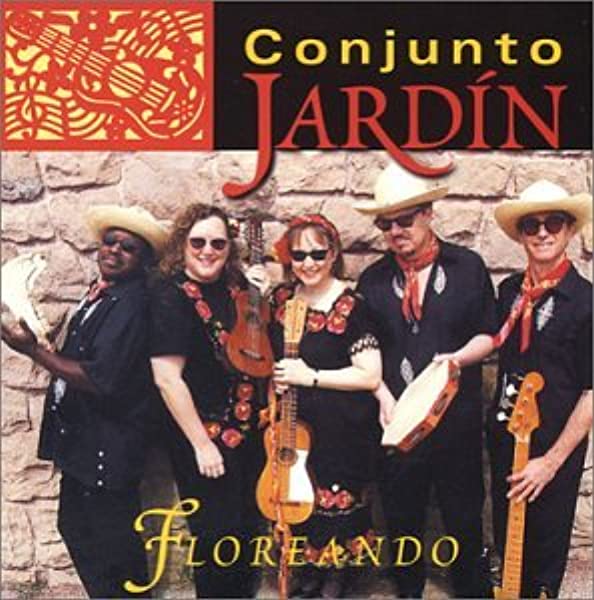
 Conjunto Jardin is a U.S.-based group that plays music in the “son jarocho” style of the Mexican state of Veracruz. Floreando means “flowering,” and refers to the efforts to preserve and revitalize this intriguing folk music. Floreando is a delightful recording, filled with unexpected sounds, danceable rhythms and plaintive vocals.
The group’s name, “Jardín,” is a play on the family name of Libby and Cindy Harding, the main vocalists. They grew up surrounded by and playing this music — their father, Timothy Harding, is a leading scholar and practitioner of son jarocho, and a virtuoso on the difficult Veracruz harp.
Most of the 11 tracks on Floreando are traditional songs, generally in the six-eight time signature that’s so common in Latin American and World music. They’re about things that Veracruz residents see in the world around them — fruits like the guanábana, birds like the kestrel (“El Gavilancito”), the gull (“El Coco”) and the blackbird (“El Pijul”) — or imagery from religious observances such as “The magic bull,” of Haiti and “La Rama” or The Branch, a Christmas carol in three parts.
The music is played on traditional instruments for the most part, including the jarana, a strummed eight-string guitar; the requinto, a picked four-string guitar; and various percussion instruments, including an eight-sided tambourine and a donkey’s jawbone. The traditional harp parts are played quite realistically on a keyboard, with parts specially adapted by group member Gary Johnson. Marcel Adjibi, originally from Benin, adds congas and other Afro-Caribbean drums, and Rick Moors plays bass. The Harding siblings play a number of instruments and sing lovely sisterly harmonies, and Jorge Mijangos, a luthier, also plays jarana and other instruments and sings.
Well, all that makes it sound very dry indeed, but Floreando is anything but. This is lively and vibrant music, and Conjunto Jardín definitely does it justice. Among the standout moments are when Adjibi contributes his smoky vocals in the Goun language, making the African connection to this music even more explicit. “El Coco” is the best example of this, a polyrhythmic song with lots of percussion, and backing singers chanting “co-co, co-co” in imitation of the seabird’s call.
Mijangos plays a wonderfully resonant baritone requinto on “La Indita” — a tribute to all the Indian mothers of Mexico — the requinto’s line winding around the vocal melody in a subtle counterpoint. “El Aguacero,” or “the rainstorm,” starts with a delicate flurry of plucked notes on requinto and “harp,” in imitation of the rain. The song is a lovely meditation on love, using rain as a metaphor.
The high point is the final, title track, in which papa Tim Harding plays his harp and sings a tribute to the jarocho musicians on both sides of the Mexican-American border. Harding’s lovely baritone is set in a traditional acoustic arrangement that lets the simple beauty of this music shine through.
Conjunto Jardin has an active performance schedule, mostly in California, and another CD as well. Go see them if you can, and check out their recordings if you enjoy Latin American music.
(Trova, 2002)
