Nanci Griffith is one of the most successful female singer-songwriters to emerge from Texas in the past 20 years. She has had a handful of mainstream country hits and has had her songs covered by country stars, but mostly she straddles the line between country and folk in the manner of fellow Texans Lyle Lovett and Guy Clark. Rounder imprint Philo has re-released Griffith’s first three albums, in which we can hear her progression from a neophyte folkie to a recognizable Texas troubador with her own unique voice.
Which is not to say that she didn’t have a unique voice to start out with. Griffith’s vocal style has a definite Texas nasal twang, to which she often adds considerable nuance, from a throaty growl to a little-girl lisp. It’s her metaphoric voice that matures over these three releases, which led up to her first bonafide hit, 1986’s Last of the True Believers.
 There’s a Light Beyond These Woods
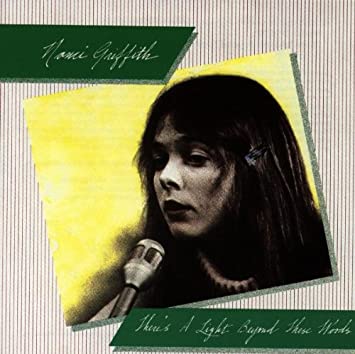
There’s a Light Beyond These Woods was recorded and released on an independent label in 1978, then reissued by Philo when she signed with the label in 1982. Overall, it’s an impressive if not terribly memorable debut, in which she shows glimpses of the distinctly confessional songwriter she was to become.
The songs are almost all portraits, miniatures if you will, of mostly rural folks: “I Remember Joe,” an old lawman; “Michael’s Song,” a poet; “Montana Backroads,” an aging cowboy; and “John Philip Griffith,” a drunk. At this point the portraits are largely static, except for the delightful title track, the moving story of two girls who grow up as lifelong friends, realizing some dreams and leaving many behind.
Griffith has surrounded herself with top-notch musicians and technicians from the beginning, including Eric Taylor, to whom she was married for a while and who has recently resumed his own musical career with gems such as 2001’s Scuffletown. The best track on Light is Taylor’s “Dollar Matinee,” sung as a duet by the two.
(Philo/Rounder, 1978 and 2002)
 Poet in My Window
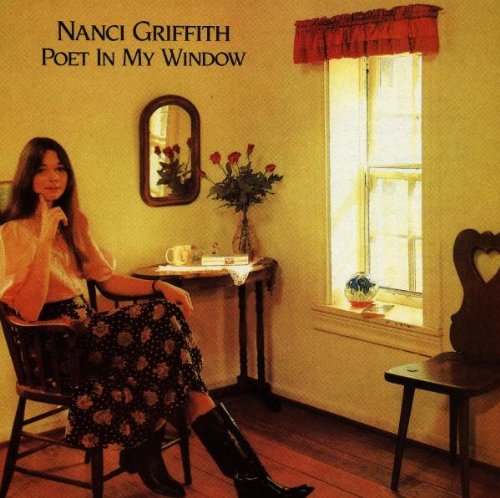
Poet in My Window shows a more self-assured Griffith, the product of a few years on the road playing in bars, clubs and coffeehouses. With the chutzpah of youth, she dedicates the album to some of the best writers and poets of the 20th Century, including Carson McCullers, Victor Jara and Thomas Wolfe, and sings several songs that are either about these artists or draw on images and themes from their works.
Griffith’s poignant and bittersweet portraits usually work best when presented with simple arrangements, such as the title track’s simple guitar and accordion accompaniment. Many of the arrangements on Poet sound very dated, which is not unusual on recordings from the Eighties. Several of the songs here are marred by too-heavy reverb on the vocals and big, booming Phil Collins-style drums. It also suffers from a lack of variety in tempos, which are generally medium, and themes, which lean toward portraits of outsiders and confessional tales of loneliness on the road.
One treat is the first track, a previously unreleased bonus, “Can’t Love Wrong,” inspired by the biography of Carson and Reeves McCullers. Another is Jimmy Dale Gilmore’s “Tonight I Think I’m Gonna Go Downtown.” In place of often belabored metaphors, Griffith could benefit from a few more catchy choruses, like the one in “Wheels,” about a Texan lost in some Northeastern city.
(Philo/Rounder, 1982 and 2002)
 Once in a Very Blue Moon
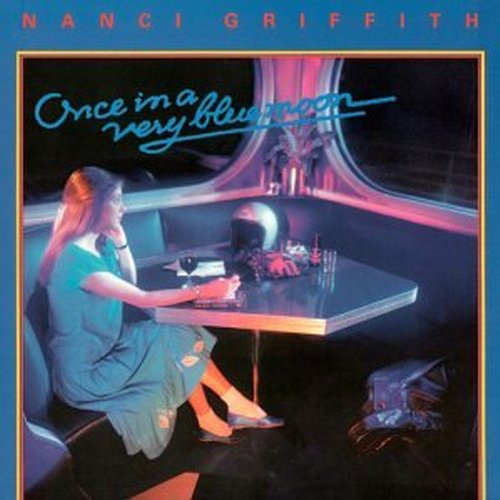
Things are really starting to gel on 1985’s Once in a Very Blue Moon, which shows a leap in songwriting sophistication, better production and more polish in Griffith’s singing. Sure, there’re still a few tepid ballads like “Time Alone,” but there’s also the perky “Ballad of Robin Winter-Smith” about the life and death of a motorcycle daredevil, and “Mary & Omie,” a first-person ballad of an African-American couple’s marriage and family.
Griffith comments on feminism in the Springsteen-esque “Love is a Hard Waltz” one of her first forays into a social type of folksong. And “Daddy Said” actually has the hard backbeat of folk-rock. The title track, written by her long-time collaborator Pat Alger, could be something out of Jimmy Buffet’s early (pre-beach) years.
Blue Moon features a stellar crew of Nashville and Austin session players like Ralph Vitello on keyboards and Roy Huskey Jr. on bass, not to mention two who were soon to be stars in their own right, Bela Fleck on banjo and Lyle Lovett on vocals. (Lovett, who released his solo debut the following year, is all legs in a group photo, surely the last time he let anyone point a camera at him wearing gym shorts and t-shirt.)
From this promising beginning, Griffith went on to become an established country folk singer who has toured the world and recorded with Harris, Clark, John Prine, Jack Elliott and a host of others. The first two CDs might be more for completists or hardcore folkies, but Blue Moon especially is a memorable statement of an artist trembling on the brink of becoming a major voice.
(Philo/Rounder, 1985/2002)
