
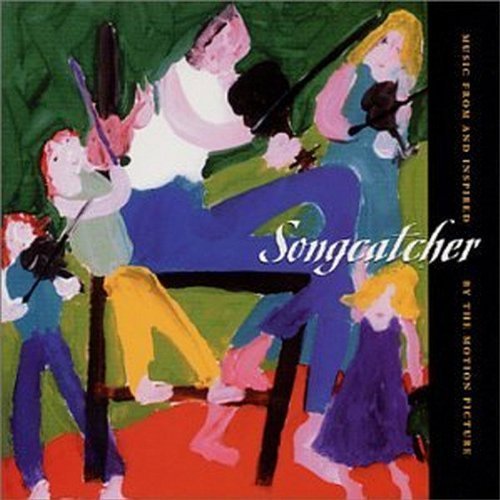
 ‘Tis the season for hillbilly music soundtracks. Perhaps hoping to emulate if not duplicate the success of the soundtrack to the Coen Brothers’ 2000 movie O Brother, Where Art Thou?, Vanguard has released a CD of “music from and inspired by the soundtrack” of a film titled Songcatcher. The O Brother CD has at this writing sold well over three-quarters of a million copies, something of a miracle for music that predates bluegrass, much less modern country.
Where O Brother is loosely based on Homer’s Odyssey and its soundtrack features mostly male singers, this Songcatcher disc is almost entirely by women, and includes some of the best, from Hazel Dickens to Emmylou Harris. In fact, it eliminates the work of Taj Mahal, who figures in the actual movie’s music, in favor of some female country artists whose work doesn’t appear in the film. That said, however, this CD has some extraordinary music.
Songcatcher the film is about a fictional female musicologist who gets drawn into the lives and music of the people of Appalachia, around the turn of the 20th Century. This was a transitional period between the Civil War and the advent of records and radio. The Scots-Irish ballad traditions of the mountainous South were being transformed slowly by the instruments (especially banjo) and cadences of African-American blues and gospel, forming what was to be marketed as “hillbilly music” by early radio and recording companies.
Only two songs and one song fragment on the CD are from the film. The best of them is Iris Dement’s “Pretty Saro.” Dement’s nasal, wobbly voice and David Mansfield’s fiddle sound as old as the very hills, which combined with modern recording techniques creates a potent and spellbinding result. The song itself, with its lilting and uneven phrasing, is obviously very close to its Celtic roots.
Actress Pat Carroll turns in a credible version of the traditional “Single Girl,” having no difficulty portraying a common woman singing with plenty of conviction but no schooling. Another young actress from the film who apparently does have some training is Emmy Rossum. Her imitation of a raw, untrained young girl singing “Barbara Allen” is fetching, and it leads into a lush yet somehow minimalist version of the same ballad by Emmylou Harris from the movie’s closing credits. As with nearly everything she does, Harris interprets the song faithfully while transcending genre and any other limitations to make it a work of potentially universal appeal.
Now is probably as good a time as any to enlarge on the contributions of David Mansfield, who was one of the musical directors of the movie and who contributes much to its soundtrack and this CD. In addition to fiddle behind Dement, he plays every instrument on Harris’s track, including mandolin, dulcimer, fiddle, guitar, bass and drums, and does it in a way that sounds like a real band. He also wrote and conducted the score, two pieces of which are included here and serve only to reinforce reviews of the movie that liken it to the sentimental Hallmark Hall of Fame series.
Sandwiched in between “Pretty Saro” and “Barbara Allen” is “When Love is New,” an utterly charming duet between Rossum and Dolly Parton, who wrote the song. Rossum’s achingly clear and unaffected alto blends perfectly with Parton’s sharp but undeniably mature “high-lonesome” soprano in this song that pits youthful passion against the wisdom of age in matters of love. Rossum’s vocals are understated but powerful, hinting at classical training, and she projects superbly without ever shouting, something that cannot be said for several other vocalists on this record. I hope we hear more from this voice.
Two hair-raising unaccompanied numbers round out the best of this disc. Gillian Welch, David Rawlings and David Steele sing an arresting three-part harmony on “Wind and Rain,” a perfect example of the straightforward style of the best of this kind of old folk music, passionate, tragic and yet very matter-of-fact. Ditto for another clip from the movie, “Conversation with Death,” which appears in the bluegrass cannon as “Oh Death.” Hazel Dickens and two actors alternate verses of the song, in which a dying man stares Death in the face and argues about whether it’s his time to go.
Rosanne Cash’s opening track, “Fair and Tender Ladies” establishes the theme of the record. Two nice inclusions on the CD are Julie Miller’s “All My Tears,” and Patty Loveless’s “Sounds of Loneliness,” both of which are contemporary but fit with the theme and feel of the older songs.
Alt-country legend Maria McKee disappointingly forces her way through “Wayfarin’ Stranger,” and Nashville divas Allison Moorer, Sara Evans and Deana Carter give too-polished renditions of “Moonshiner,” “Mary of the Wild Moor” and “The Cuckoo Bird” respectively. I’m not complaining, because it’s encouraging to see some mainstream artists recording more rootsy material, and it gives rise to the pleasant fantasy of major-label Nashville actually producing something besides by-the-numbers pop for the masses. Roots revivals usually take place in times of stagnation in popular music, so if nothing else, we can look back in another decade or so and see whether what we’re seeing now is a real revival or a brief flash in the pan.
Again, it would have been nice to hear some of Taj Mahal’s contributions to the film on this CD. I’m curious to see how they compare to work he did in the early ’70s on the soundtrack to Sounder, and a male voice (not to mention an African-American one) would provide a little variety here. The only other flaw I see is the sequencing; the record peters out in the second half.
But Songcatcher the CD is overall a wonderful thing, full of authentic roots music. At its best it is excellent, and its missteps are still better than most country music being created today.
(Combustion/Vanguard, 2001)
