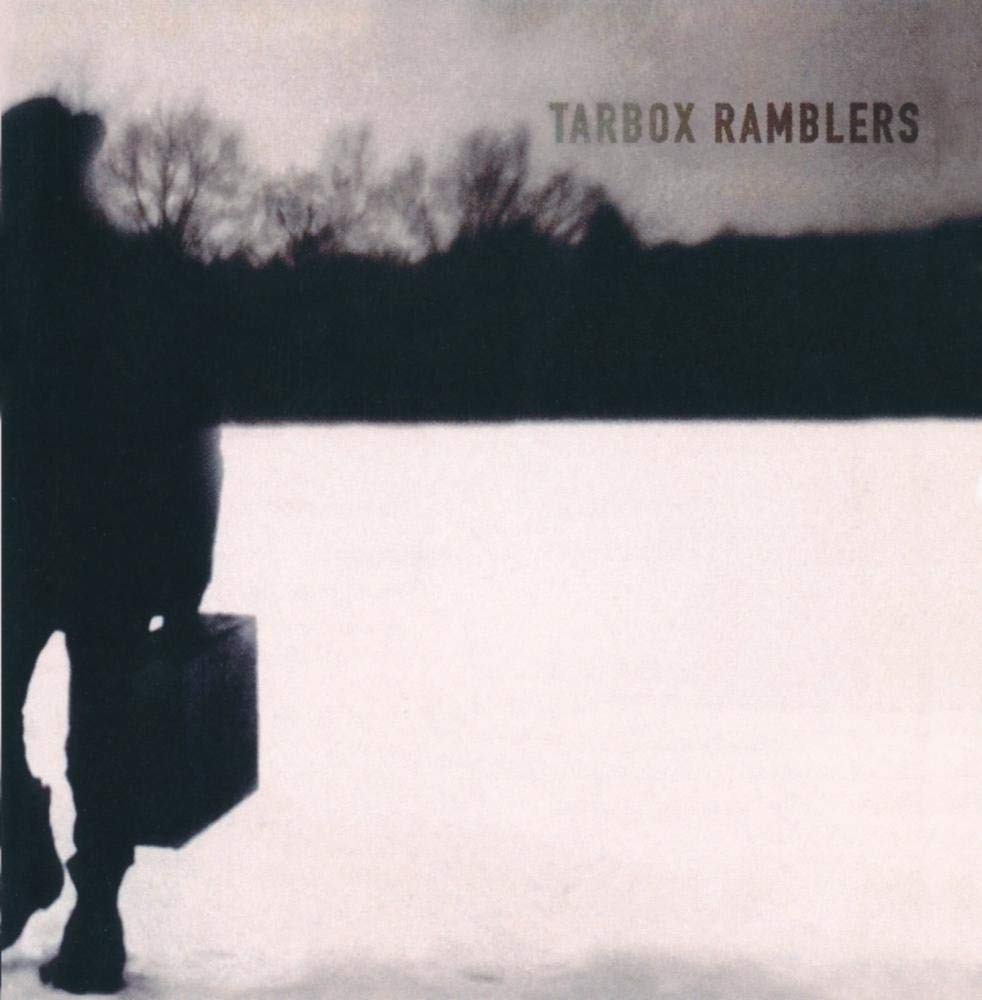
 A lot of bands make what is called “roots rock,” but Boston’s Tarbox Ramblers are so close to their roots that if you gave them a good shake, bits of dirt and loam and I don’t know what-all would probably come flying off. Their debut CD on Rounder is a thick, dark Gothic stew that’ll stick to your ribs and still have you coming back for seconds.
It’s my guess that the Ramblers have spent a lot of time digging around in the Harry Smith Anthology of American Music, as well as a lot of old Folkways and Alan Lomax archives. Which is nothing new. American (and not a few English) musicians have been reaching into those bags of tricks for inspiration since the great folk revival of the 1950s. And like many of their forbears of the past half-century, this band has put its own stamp on the material they unearthed.
The end product is an album of old-time southern traditional folk, hillbilly, gospel and Delta blues played by a string band that combines electric and acoustic sounds and a seriously swinging rhythm. The sound is built around the distorted guitar and gravelly vocals of Michael Tarbox and Daniel Kellar’s jazzy violin. A bass fiddle lays down a solid rhythm, recorded with a big, sustained sound. Simple percussion provided by an ominously hollow bass drum thump and syncopated tom-toms emphasize the swinging rhythm as well as the dark atmosphere.
The whole record, clocking in at about 42 minutes, would fit comfortably on an old vinyl LP — and the Tarbox Ramblers would probably prefer it that way, but they came along about 20 years too late for that.
There are no real revelations here, but the band’s approach to the material is effective. The opening track “Jack of Diamonds” starts off with a fingerpicked intro by Tarbox that sets the mood of the whole record. On the next, “Honey in the Rock,” a swinging gospel number, Tarbox plays a mean bottleneck, and Kellar turns in a sweet fiddle solo — as he does on nearly every number.
Considering the band’s limited instrumental range, the album is surprisingly varied sonically. Bukka White’s “Shake ’em On Down” is punctuated by a double-kick bass drum and shouts and hollers from the band; the gospel field chant “Stewball” (not the Peter Paul and Mary ballad) is given a nearly a capella, call-and-response treatment; and “Oh Death,” with its strident slide guitar and powerful vocals, has echoes of Furry Lewis.
The band gives a straightforward rendition of “St. James Infirmary,” and a very primitive sound to “No Harm Blues.” The slowest song on the album, “The Cuckoo,” is also the most powerful, with its brooding “House of the Rising Sun” ambience. Tarbox’s slide work is strong yet subtle, Kellar’s fiddle sinuous and the uncredited mandolin playing is eerily spare.
The CD doesn’t come with much in the way of liner notes, but I wouldn’t be surprised if the entire thing was recorded “live” in the studio. It just has that spontaneous, live feel and sound.
This is pretty powerful music, both in its original form and in its rocked-up Tarbox version. It’s encouraging to see a band carrying the old songs and forms into yet another century, paying homage to the music while giving it a fresh interpretation.
(Note: This title has been reissued by UMG/New Rounder as A Fix Back East.)
(Rounder, 2000)
