
 Bill Lamey is one of the best-known and most influential Cape Breton Island fiddlers in the world — to other Scottish-style fiddlers. Rounder has brought Lamey’s music, previously known mostly to other fiddlers and those lucky enough to have heard him play during his lifetime, to the rest of the world’s Cape Breton music fans.
Lamey was born in 1914 and died in 1991. He started playing fiddle when he was 18, and through the 1930s and 1940s played many dances, house parties and radio shows in Cape Breton Island, Nova Scotia, Canada. He made several 78 rpm records in the 1940s which became classics of the genre, and which were compiled on an LP by Shanachie in the Seventies. Lamey moved to Boston with his family in the early 1950s, and remained there until he retired from his “day job” in the Seventies, when he moved back to Cape Breton.
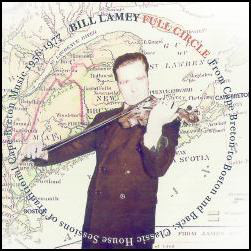
This is a very impressive CD package. Subtitled “From Cape Breton to Boston and Back: Classic House Sessions of Traditional Cape Breton Music 1956-1977,” it contains 70 minutes of music, about as much as you can pack onto a CD. The booklet is so thick it barely fits into the CD jewel case, and is excellently written and designed. It tells the story of the makings of these recordings, and has a short biography of Lamey, testimonials from numerous modern Cape Breton fiddlers, notes on the accompanists, and detailed notes on each of the medleys and tunes on the disc’s 17 tracks. Even the CD itself is beautiful, with a sepia-toned photo of Lamey as a young man, standing in somebody’s yard, holding his fiddle, dressed in a sharp double-breasted suit.
The music is spellbinding. It’s clear why the man was so influential on today’s generation of fiddlers, including Jerry Holland, Natalie MacMaster and Alasdair Fraser.
The recordings are almost all from tapes made by private individuals at house sessions or parties during the years mentioned in the CD’s title. The tapes have been duplicated and swapped by devotees of the music for the past 50 years, before Lamey’s family and Rounder collaborated to remaster them and put them on CD.
What that means, of course, is that these are not studio-quality recordings. But the vibrancy and quality of the music comes through loud and clear. I found that the best method of listening to this disc is to turn it on fairly quietly, and imagine that I’m standing just outside the room where Lamey and his accompanists are playing, or outside the hall where there’s a party or dance going on.
There’s so much good music here that it’s hard to single out tunes or tracks. Among the ones that I keep going back to are the first track, comprising a waltz, strathspey and two reels (“The Duchess of Athole’s Favorite,” “Dusky Meadow,” “Miss Proud,” and “Major David Manson”), and the eleventh, an air, two strathspeys and two reels (“Inverary Castle,” “The Corbey and the Pyett,” “Struan Robertson’s Rant,” “Miss Flora MacDonald’s,” and “Mrs. Melville-Dysart”).
It’s too bad that Lamey was never recorded using modern professional equipment and techniques. But Full Circle will ensure that Lamey’s legacy will be carried on to yet another generation of players and listeners.
(Rounder, 2000)
