
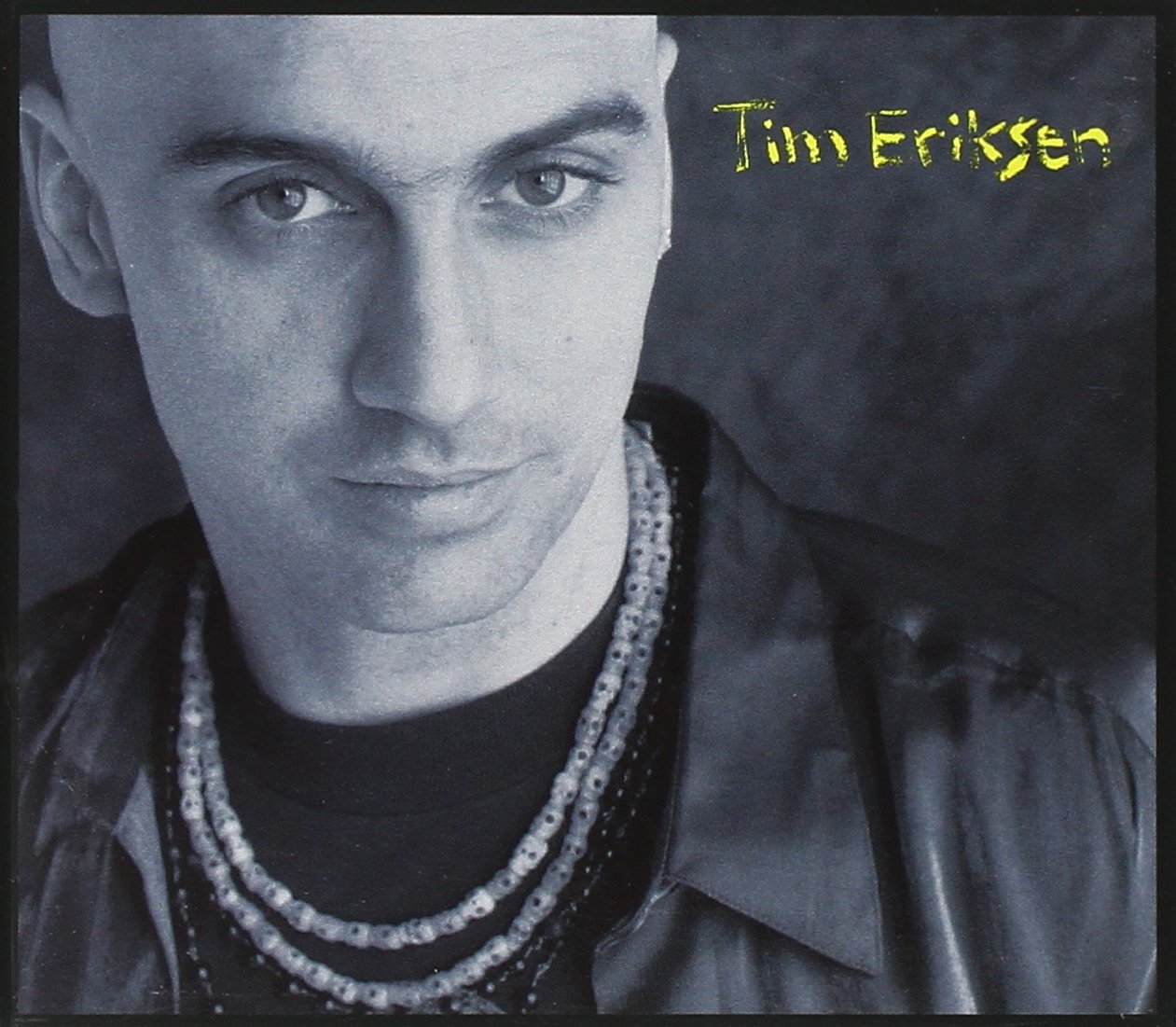
 Spine, by Cordelia’s Dad, was one of my favorite discs of 2000, and it remains among my frequently played CDs. Tim Eriksen, the frontman of Cordelia’s Dad, presents a heartfelt solo debut with roots deep in American traditional music. The Massachusetts musician, in addition to leading a punk band, has become something of a scholar of 18th and 19th Century American music, from shape-note hymns to murder ballads, and he presents 14 starkly beautiful tracks on this record.
Accompanying himself mostly with acoustic guitar but occasionally on banjo or fiddle, Eriksen recorded the entire album live, with no overdubs, in about five hours in the studio. The setting of each song is appropriate, whether a capella or with instrumental backing. Eriksen’s voice has an old-time, nasal, but also warm quality to it, which comes across very clearly in these unmanipulated recordings.
Two instrumental tracks stand out. One is a polka-hornpipe set by William Sidney Mount, a New York painter and fiddler from the mid-19th century. Eriksen fingerpicks the guitar impressively on the “Mobile Serenade Polka/Shep Jones Hornpipe.” The second instrumental is a solo banjo piece, “Last Chance,” dedicated to Ellis Wolfe, an old Tennesseean who made Eriksen’s banjo.
Eriksen seems undaunted by several rigorous a capella songs, including the opening “Farewell to Old Bedford,” “Dress it in Blue,” a ballad of an encounter between a sailor and a “maid,” the Thomas More hymn “Hope,” and “Village Churchyard,” an eight-minute spooky tale of death from Roscoe Holcomb’s songbook. All of these numbers, particularly the last, evoke very old times in both their lyrics and their melodies. Eriksen has mastered older styles of singing, with clipped words at the ends of lines, and in the case of “Churchyard” a series of challenging glissandi in the middle of each verse.
Several of Eriksen’s songs are lengthy, well over five minutes. They hearken to a time when people were accustomed to gathering around the fire at night to listen to long songs and longer tales. Many of these songs perfectly fit that type of atmosphere, too — tales of murder, mayhem, betrayal and suicide, with the odd love song tossed in for good measure.
There’s “Boston,” a ballad from the American Revolutionary era about a shipload of folks lost at sea, casting lots to see who will get eaten first. And another from that era, “I Wish the Wars Were All Over,” in which a lass laments the loss of her sweetheart. This one, with its percussively plucked guitar accompaniment, calls to mind the type of old English songs Bert Jansch was recording 30 years ago.
“Hicks’ Farewell” is a preacher’s deathbed lament; it and “Garden Hymn” are shape note-style hymns from the Sacred Harp songbook, and Eriksen plays suitably ancient-sounding fiddle on both.
Eriksen has a powerful voice and attacks these songs passionately. When he sings toward the upper end of his vocal range for several songs in a row, as he does in the second half of the disc, the cumulative effect can be overwhelming. He’s a little easier to take as a member of Cordelia’s Dad, with some additional musicians and backing vocalists to temper this effect.
The final three tracks are striking. Eriksen sings all of them in a more relaxed and understated style at the lower end of his range, and the contrast is effective, although perhaps they could have been sequenced differently for variety’s sake. “Brown Girl” is a long Frank Proffitt ballad about forbidden love and jealousy and murder; “Leave Your Light On” and “I Love Music” are both Eriksen compositions. The former, with strummed guitar accompaniment, is a cryptic love story that evokes Curt Cobain in his quieter moments; “I Love Music” features harp-like plucking of the guitar that creates dissonant overtones behind the droning vocals.
In spite of the acoustic settings, this is intense music, much of it springing from the time when Americans were beginning to create their own music out of old European folk traditions. Even without any of the trappings of modern pop music, these songs get right in your face and demand attention. Don’t be shy. Pay attention, and you can even sing along if you want.
(Appleseed, 2001)
