
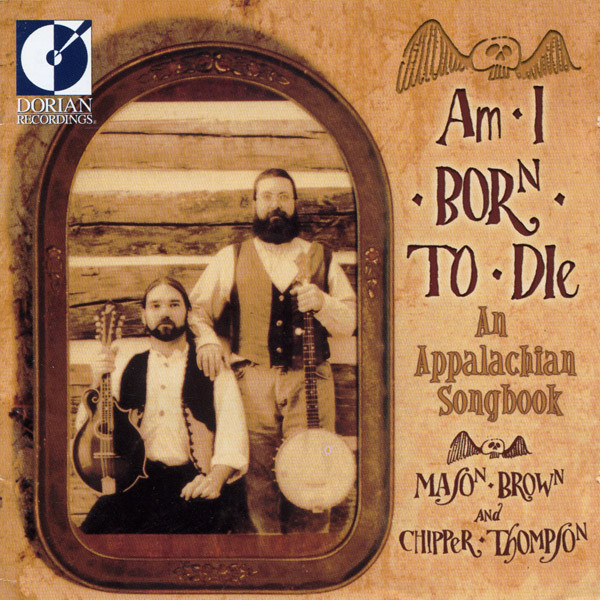
 An album of old-time American music performed by a couple of New Mexicans, on an artsy independent label based in upstate New York may seem an unlikely thing. But Am I Born to Die is a beautiful and moving piece of work.
Subtitled “An Appalachian Songbook,” the CD’s cover touts it as “Celtic songs of love & war! Appalachian murder ballads!” All but one of its 15 songs are traditional, and all are played on more or less authentic period instruments, including a restored 1925 guitar and an old-time open-backed banjo. There’s lots of mandolin thrown in for good measure, even though, as the liner notes explain, it was mainly thought of as a classical instrument until Bill Monroe put it at the front of his seminal bluegrass band.
And then there’s the bouzouki. No, this Greek zither is not actually an Appalachian instrument, but it has become common in modern Celtic bands. And the way Chipper Thompson plays it, it sounds like it belongs here — somewhere between a dulcimer and mandolin. Well, except when he plays it with a bottleneck slide; then it sounds like nothing you’ve ever heard before.
Brown and Thompson also take some liberties with the songs themselves, sometimes combining verses from several different versions — as in the upbeat, bluegrassy romp through “Jesse James,” featuring slide bouzouki, banjo and acoustic bass. Or the “Appalachified” version of the murder ballad “Bruton Town,” best known to my generation from Sandy Denny’s version. Or the new melody Brown wrote for the morality tale “The Pesky Sarpent” because the published melody was “stilted and out-of-date.”
This is exactly what folk music has always been: taking the old songs, learning them well, then making them your own. And it’s the way the old songs will stay with us and continue to be relevant as a living art form.
Both Brown and Thompson have craggy, mid-range baritone voices, and they take turns singing lead and accompanying each other with high-lonesome harmonies. Brown’s is a warm, buttery voice used to good effect on ballads like the opening track “Pretty Peggy-O,” well known to Simon and Garfunkel fans. Thompson’s slightly rougher voice is well suited to raucous songs like “Jesse James” and the foot-stomping “God Moves on the Water,” a gospel-blues take on the story of the Titanic, told from the point of view of an African-American man who was refused passage on the liner because of his race.
The liner notes in the 24-page booklet could be better edited. It’s nice to have the lyrics, though. The booklet’s design goes off the deep end with the old-timey stuff, particularly the back-cover photo of the two musicians in western outlaw gear more appropriate to Dodge City than the Appalachians – although I guess it’s appropriate for singing “Jesse James.” And the notation of which man is doing “lead singin’ ” and “harmony singin’ ” crosses the line into self-parody.
But there’s nothing wrong with the music, and that’s what’s important. The title track is guaranteed to raise the hair on your neck. Accompanied only by a droning deep bass fiddle, Brown and Thompson moan out this old Baptist funeral hymn that asks the eternal question, “Soon as from earth I go/What will become of me?” If they keep making music like this, Mason Brown and Chipper Thompson are guaranteed reservations in the heavenly choir. Learn more on Discogs.
(Dorian, 2001)
