Joan Baez occupies a revered place in the rebirth of folk music in America in the second half of the 20th century. Now after many years when her early, most influential recordings were available only on various compilations, Vanguard has begun the process of re-releasing in chronological order all of her albums on that label.
A teenager with Mexican-American and Irish roots, Baez in her 1960 debut came seemingly out of nowhere, fully formed as an interpreter of America’s anglo-celtic folk music. The folk revival was underway, and an urban folk scene was developing in New York City — particularly around Greenwich Village and Washington Square — and the rest of New England. Baez, whose father was a university professor, had moved with her family to Boston from California, and at 17 she enrolled in the Boston University School of Drama.
She immediately became part of the folk scene and was soon playing and singing at coffeehouses in Cambridge and Boston, where she came to the attention of Albert Grossman, who became her manager. With him she traveled to Chicago, then appeared as a guest of Bob Gibson at the first Newport Folk Festival, and at the age of 18 signed a recording contract with Vanguard.
These three CDs document Baez’s rise from neophyte to journeyman recording artist and performer.
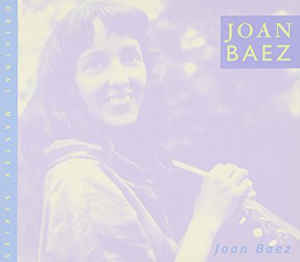 Joan Baez
From the opening of the first track, “Silver Dagger,” it’s apparent that Baez is something more than just another teenaged girl with a guitar. After a brief fingerpicked introduction, she sings the first words, “Don’t sing…” and it could be any of a number of other young female folksingers. But when she gets to the next two words, “…love songs,” that clear soprano with its startling vibrato kicks in, and you have to sit up and take notice.
It’s a brave choice for the first track of a debut album. She’s still young, obviously, still naive and even a little callow, but yet somehow recognizable as a major voice — maybe that’s 20/20 hindsight, but Vanguard’s Maynard Solomon heard it and believed. She sings with such conviction verses like this one, hardly standard fare for girl singers at the time:
My Daddy is a handsome devil
he’s got a chain five miles long
on every link a heart does dangle
of another maid he’s loved and wronged.
Much has been made of her ability to interpret and portray the emotions of a song, but in this first record anyway, her bag of tricks consists mostly of exploiting her dynamic range, from a piercing forte to a near-whispered piano; still, it’s an impressive solo performance for a 19-year-old.
Baez sings at least one number on each of these three records in a foreign language: “El Preso Numero Nueve” in Spanish on the debut; “Plaisir d’Amour” in French on Vol. II; and a couple of carols in German on Noël. It’s instructive to compare this version of “El Preso” with the one she recorded a dozen years later for her all-Spanish album, Gracias a la Vida. In the earlier version, she summons all the indignation available to a teenager railing against injustice, but it’s only in the later version that she sings with the hard-won understanding of an adult with some concept of her own mortality.
Each of these reissues has some bonus tracks, and most are worthy inclusions. On Joan Baez they are an extended version of “John Riley,” the blues standard “I Know You Rider,” and “Girl of Constant Sorrow,” her own customized version of the song that has become a huge international hit in the past year on the soundtrack of “O Brother Where Art Thou.” It’s clear why “Rider” was left off of her debut — her reading of even this fairly upbeat song shows a singer not yet ready for the blues.
 Vol. II
Vol. II shows the singer already much matured. She sounds 10 years older, not just the year that she was, when she sings “I don’t need no man” on “Longest Train I Ever Saw,” one of three nice bonus tracks included here. In another bonus track, she gives a heartfelt reading of “I Once Loved a Boy,” accompanying herself with delicate fingerpicking.
Also on Vol. II she gives a straight and unaffected version of “Barbara Allen,” and a devastatingly powerful rendition of “Once I Knew a Pretty Girl.” Her “Banks of the Ohio” is in four/four, not three/four time as most other versions I’ve heard. Baez’s imitation of Maybelle Carter’s drawl on “Engine 143” rings somewhat false and seems affected. The presence of members of the Greenbriar Boys on several tracks gives the album some needed variety, and helps to break up the unremittingly somber mood of just Joan and her guitar.
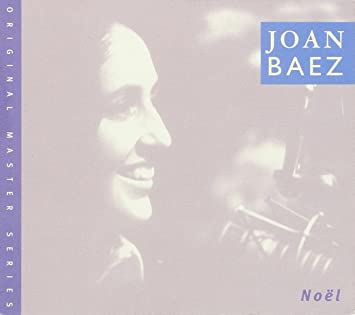 Noël
Noël
Baez’s Noël is a good Christmas album, and was probably a bit ahead of its time. The arrangements by the then relatively unknown Peter Shickele generally provide an excellent frame for Baez’s readings of these songs. Most feature classy arrangements on period instruments like lute, harpsichord, Baroque organ, recorders and viols, and other wind and string instruments.
Noël contains 23 tracks (six bonus tracks) including seven brief instrumental interludes. Some of the instrumentals are quite pretty, while others, like “Good King Wenceslas,” sound like P.D.Q. Bach tunes. These might not have sounded funny in 1966, but in a post-Monty Python world, they’re hard to listen to without sniggering.
The highlights on the vocal numbers include the opening “O Come, O Come, Emmanuel,” with a nice contrapuntal string backing; “I Wonder as I Wander,” with a solo flute introduction that, combined with Baez’s soprano gives the whole song a crystaline, ice-cold atmosphere; a beautiful arrangement of “Down in Yon Forrest,” an uptempo rendition of “What Child is This” accompanied by classical guitar, plucked cello and flute, “Cantique de Noël,” the German version of “O Holy Night,” and a hushed and reverent arrangement of “Silent Night,” which ended the original album.
Of the bonus tracks, the Baroque instrumental treatment of “We Three Kings” is quite nice, and the folky gospel hymn “Virgin Mary” adds welcome variety. Not everything works as well. Baez gives as tasteful a reading of “The Little Drummer Boy” as I’ve ever heard, but the arrangement gets a little heavy handed. “Carol of the Birds” comes off as a film-score or art song that doesn’t really fit the atmosphere of the rest of the album, and the quasi-operatic treatment of “Ave Maria” in German strains Baez’s vocal abilities a little. The bonus French version of “Away in a Manger” is quite nice; it’s a cute little tune and it sounds sweet in French. The English version uses the same instrumental tracks, a tasteful arrangement of lutes and bells, but even that fails to make up for English lyrics’ sentimental twaddle.
In his liner notes, Shickele says that Baez was a pleasure to work with, focussing on the business at hand, but also showing “a terrific sense of humor which, if you knew her only through her recordings, you might not have expected…” It’s a telling comment. After listening to any one of these albums straight through, I wanted to tell her, “lighten up a little, Joan.”
These three releases are color-coordinated, their covers consisting of pastel duotone period photos of Baez. The debut’s new cover photo is particularly nice, with Baez as a female Tom Sawyer, with big toothy grin and her guitar over her shoulder. A nice touch is the original album cover art on the back of each booklet. Original liner notes are included, augmented by new notes from Shickele and music historian Arthur Levy.
By one count, Baez recorded 17 albums for Vanguard, and the label says it plans to rerelease all of them. It’s welcome news, and the completed set should cast a welcome retrospective light on the folk revival and its aftermath, as illuminated by one of its most important figures.
Find out more at Joan Baez’s website.
(Vanguard, 1960, 1961, 1966; reissues 2001)
