
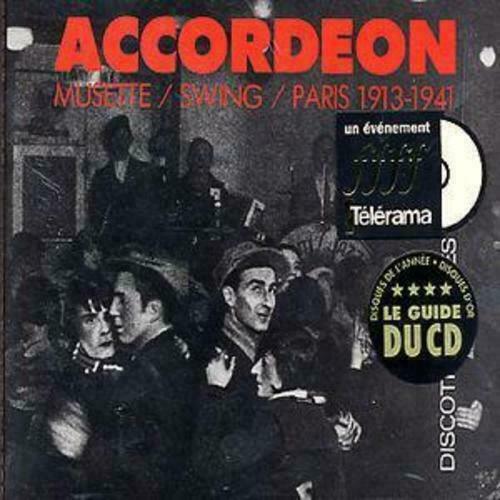
 As New Orleans has its jazz and Chicago its blues, Paris has its musette, a musical form indelibly associated with the city on the Seine. This outstanding two-CD collection traces the history of the musette, a music that came out of the dance halls of the working class.
The music of the bal musette or dance halls was a melange of waltzes, polkas, paso-dobles and mazurkas, with fox-trot added during World War I and swing during World War II. The music and its chief instrument, the accordion, was brought to the City of Light by immigrant rural folks seeking work.
The accordionists came from France, Belgium, and especially Italy, and they borrowed styles from their home countries as well as the Spanish, the gypsies and Americans. Edith Piaf began her career in the bal musette, and she pays tribute to the form and the musicians in one of her best-known songs, “L’accordioniste.”
This music is very appealing, evoking as it does the romantic cafes, sidewalks and dance halls of Paris. It’s instantly recognizable, with its minor keys that speak of an underlying sadness, coupled with jaunty melodies and sporty playing styles that reveal the resilience of the human spirit. “Life is short and sad, so let’s dance,” it seems to say. Not a bad philosophy.
With well over two hours of music that ranges from 1913 to the 1940s, this collection is chock-full of little gems, including Piaf’s “L’accordioniste,” in which she’s accompanied by Gus Viseur. There are higher-fidelity versions of this piece in other Piaf collections, but this one is passionately rendered by both the vocalist and the accordionist. Viseur’s work here is unfailingly excellent, and ranges from waltzes to polkas and mazurkas and includes perhaps his best known, Flambée Montalbanaise.” “Valse de minuit,” on which he is accompanied by Argentine guitarist Oscar Aleman is a treat, as is the exotic mazurka “Miliana.”
Django Reinhardt appears on a couple of tracks of the second disc, accompanying the Italian gypsy accordionist Guerino. Both are excellent waltzes featuring guitar and an unnamed violinist.
Some of the tracks are good examples of the kind of music that eventually gave the accordion a bad name by mid-century. These tend to be fox-trots and polkas, or oom-pa-pa type waltzes that call to mind lederhosen and Tyrolean hats. Several examples of a briefly popular style of song in which the accordion plays on the upper register and mimics the sounds of birds are also included. Other pieces featuring xylophone accompaniment tend to jangle the nerves, and a few of the more up-tempo waltzes bring to mind the circus.
Balancing out the more treacly works are some wonderful swing pieces, including Reinhardt and Grapelli’s composition “Swing 39” and the standard “Swing Valse,” both played by Viseur. Tony Murena’s “Melancholie” is sublime, and Jo Privat’s syncopation in the fox-trot “Mefiance” adds color to a form that tends to be less interesting than the more dynamic waltz and mazurka.
The CDs are accompanied by a 40-page booklet in French and English, with good documentation of the music and the musicians (including some photos), and an excellent history of the musette and its influences. All in all, this is an excellent slice of musical history well preserved, and a delightful listening experience.
(Discotheque des Halles, 1992)
