
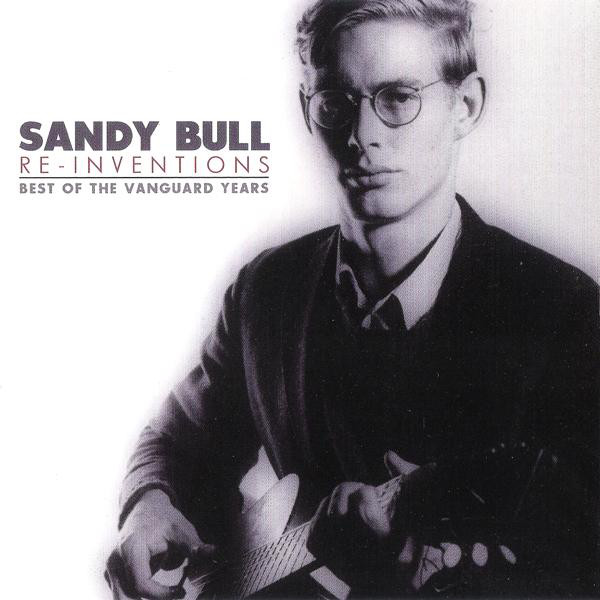
 I wasn’t familiar with Sandy Bull’s name when I got this CD, and as the very informative booklet accompanying the CD said, I am apparently in fairly good company. Sandy started recording for Vanguard Records in 1962, and spent 10 years on this label, releasing a series of albums that drew from the eclectic musical background to which he’d been exposed by both of his parents. This all-instrumental sampler album draws from classical, blues, country, jazz and middle Eastern influences, and Bull’s virtuosity on instruments such as the oud, guitar, banjo, bass, and such non-traditional instruments as the spare change in his pocket is shown to very good effect. Bull’s recording career took a hiatus while he successfully battled drug addiction and had time off to start a family. He returned to recording in 1988 and has had two other albums released since then, in ’91 and ’96 for Timeless Recording Society.
The opening track, “Blend” takes up close to a third of this album, and is a 21-minute long hypnotic dialogue between Bull and drummer Billy Higgins (whom Bull had met while Higgins was working with jazz sax player Ornette Coleman). This one-take tour de force starts slowly with Bull’s minor key, raga-esque guitar playing punctuated by Higgins’ percussion It alternates between a rather spare call and response between the two musicians, with plenty of negative musical space, to a dense wall of sound between the two where so much is happening that it’s hard to decide who to concentrate on. I could close my eyes and visualize the two musicians making auditory and visual contact with each other, connecting with each other in a way that makes this track a magical moment for players as well as listeners.
Next up is Luiz Bonfa’s “Manha da Carnival.” This track, while nicely played, is marred by very audible hiss and breathing noises from Bull, who was doing his own dual-track recording in his living room at the time. Perhaps listening on headphones here is not the way to go; every flaw is exposed. Bull uses oud as his primary instrument, while accompanying himself on Martin guitar and bass. It should be noted that this recording was from his earliest album and is considerably more crudely recorded than some of the later material.
The third track, a fantasy based on Carl Orff’s Carmina Burana, is played on five-string banjo. The arrangement is very nice and the technical ability needed to pull it off is most impressive (and he definitely has it!). I love Carmina Burana in its fully scored instrumental/vocal version, but the limited tonality of the banjo made me wish he’d chosen to play it on guitar instead, which I think would have been a more suitable choice for this particular piece.
What works really well for me is the next track, called “Gospel Tune,” where Bull’s tremolo-laden Stratocaster plays homage to Pops Staples in a bluesy almost 10-minute-long reverie. Bull accompanies himself on hi-hat very effectively here.
Chuck Berry’s “Memphis Tennessee” finds Bull re-united with Billy Higgins but there are some seeming disconnects between Bull and Higgins which don’t sound planned. Bull plays guitar (both lead and rhythm) and bass on this track, and although he takes the song to a few places it doesn’t usually go, I thought the length could have been trimmed without losing its originality. Quite frankly, Higgins’ drumming seems to me as if he was bored during this recording.
Track 7 switches musical styles quite abruptly, as Bull plays Guillaume de Machaut’s 14th century “Triple Ballade” music on guitar and banjo.
The CD finishes up quite nicely with “Carnival Jump” from his last Vanguard release. I’m not sure how the name of the track connects to the music, which is more a whirling dervish-like, middle-Eastern polyrhythmic affair. By the way, if you were wondering where the spare change is used as an “instrument,” this is the track! He is accompanied by the late Dennis Charles (to whose memory this CD is dedicated) on hand drums.
This sampler definitely accomplishes its intent, which is to make me want to go out and get a feel for some of Bull’s other work.
(Vanguard, 1999)
