
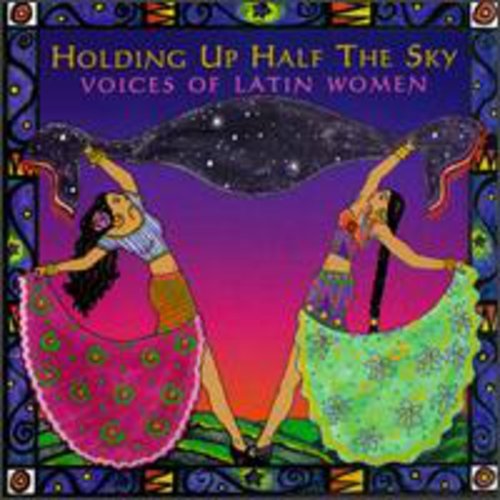
 Shanachie and producer Daisann McLane set out with a modest goal for this CD: To introduce listeners to the joys of Latin American women singers. They’ve succeeded quite nicely.
Holding Up Half the Sky contains nearly an hour of varied music from 13 artists. The selections range from ballads to hot dance numbers from the Sixties through the Nineties. The artists themselves represent — besides the expected Cuba and Mexico — Peru, Puerto Rico, the Dominican Republic, and Colombia. Stylistically, they cover a wide swath that includes big-band salsa, accordion-driven folk, Afro-Caribbean drum-based call-and-response chants, and more.
The collection is fairly heavily weighted with salsa and similar big-band styles, which account for six of the tracks. But it has just enough leavening of other styles to keep it interesting.
The most amazing cut is a machinegun-tempo merengue by Fefita La Grande of the Dominican Republic. This over-the-top grandmother plays accordion at an absolutely breakneck tempo as she sings and howls out “Me Pusieron Trampa.” She’s backed by an equally skilled saxophone player, and percussion that may or may not be synthesized. Either way, it’s an electrifying performance; I’d love to see her live — she reportedly boasts that she plays 364 nights a year and keeps a pistol in her accordion case.
Some of the Grand Dames of Latin music are represented by signature songs from their long careers. They include Tex-Mex crooner Lydia Mendoza’s “Aunque Me Odies,” Lola Beltran of Mexico with “Gritenme Peidras del Campo,” and Cubanas Maria Teresa Vera (“Veinte Años”) and Celia Cruz (“Caramelos”).
There are also voices from this decade, including the late Patricia Teheran of Colombia, who plays accordion and sings, backed by her band The Goddesses, on a tender love song to a married man, “Tarde Lo Conocí (I met you too late)”; and pop singer Albita Rodriguez, who defected to the U.S. from Cuba in the early Nineties.
I don’t find much to dislike about this collection. I’m not crazy about the stylings of some of the Sixties salsas, including the album-opener, La Lupe’s “Besito Pá Ti,” even though it was arranged by the great Mongo Santamaria. I keep expecting to hear Ricky Ricardo warbling “Lucy, I’m Home.” It’s especially instructive to compare it with “Llegó La India,” by Puerto Rican-born New Yorker, Lindabel Caballero. They’re working essentially the same style, but now in the Nineties, Caballero is allowed to behave more like an American pop star than a Chiquita-Banana novelty act.
But I can’t argue with La Lupe’s inclusion on this collection as a groundbreaking Latina singer. I’d just like to see more in the vein of Peruvian Lucila Campos and her traditional son-like style based on guitars, men’s and women’s chorus, and box-drums called “cajas.”
The liner notes by the producer are copious, although I do wish they included dates of the recordings, the names of the musicians involved, titles of the albums on which each track originally appeared, etc. Sometimes it’s not clear even in which decade a song was recorded.
Latin American music has gained a lot of attention in the past two years, especially from the much-heralded releases by members of Cuba’s Buena Vista Social Club, and the Tex-Mex super group, Los Super Seven. Those groups are almost entirely dominated by men, however. The aptly titled Holding Up Half the Sky is a good starting place for those who want to explore music made by Latina women.
(Shanachie, 1998)
