
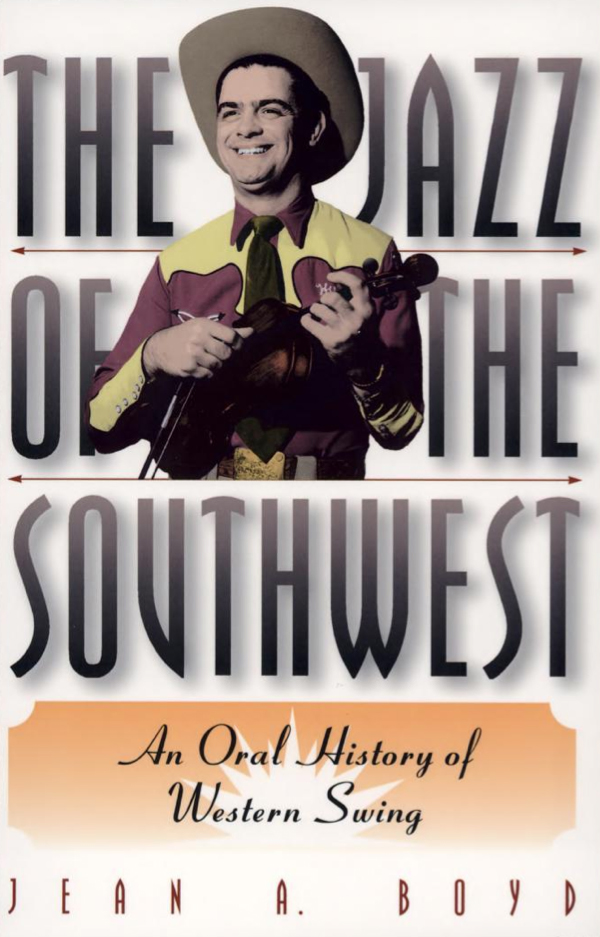
 For about 20 years, from the mid-1930s to the mid-1950s, Western swing was one of the most popular types of music in America. At its peak in the late 1940s, the biggest of them all, Bob Wills’ Texas Playboys, was more popular and sold more records than the top Eastern swing bands.
This was not country music. It was jazz, pure and simple. Jean A. Boyd, who teaches musicology at Baylor University in Waco, Texas, amply documents that assertion in The Jazz of the Southwest.
It was dance music with a strong swing beat, featuring improvisation and interpretation like other types of jazz. It was built around the instruments found in rural string bands — fiddle, guitar, steel, banjo and bass. And it drew on the music popular among rural residents of the Southwest: country, blues, German polkas and waltzes, Mexican dance music, Cajun and pop.
The players of Western Swing identified mostly with jazz musicians they heard on record and radio. Swinging jazz beats were taking the country by storm in the late Twenties and early Thirties, and fiddle players and guitarists in Oklahoma and Texas were greatly influenced by the sounds of Stuff Smith and Stefane Grappelli, Django Rhinehart and Charlie Christian, Louis Armstrong, Count Basie, and Nat Cole.
The first Western swing band was formed by Milton Brown, when he added a piano and steel guitar to his Musical Brownies and began to emphasize jazz stylings. When Brown died in 1936, Bob Wills, who had played fiddle with Brown in an earlier band, carried Brown’s ideas further, adding horns and further emphasizing the swing beat.
During and shortly after World War II, Wills moved to California to be close to the burgeoning entertainment industry. There, for another decade or so, his band prospered, as did offshoots and competitors like Spade Cooley and Tex Williams and their bands. Rock ‘n’ roll dealt a near-fatal blow to Western swing in the late Fifties and Sixties, but it made a comeback of sorts in the late Seventies, which continues today.
Boyd subtitled her book “An Oral History of Western Swing.” Much of her material was drawn from interviews with surviving members of the bands from Western swing’s heyday, many of whom are still touring, playing, and recording with revival bands. Boyd admits in the book’s conclusion that she has just scratched the surface of what could be written about Western swing, and hopes that her book provides the framework and impetus for further research.
Jazz of the Southwest is organized around the instruments that made up the classic Western swing bands, starting with fiddle and guitar. Each chapter opens with a history of the instrument in jazz in general, then tells how it fit within the Western swing band. The bulk of each chapter is biographical material on some of the chief players of each instrument in the band, drawn from interviews and other sources. In addition to fiddle and guitar, other chapters cover steel guitar, the rhythm section (banjo, bass, piano and drums), horn players and singers. There’s a short section of photographs of some of the major bands and a few individual musicians.
Boyd knows her subject and amply backs up her thesis. This is an important work, in that it documents an era from the point of view of its participants, while some of the key players are still alive. It’s too bad the book itself isn’t as vibrant as its subject matter. Boyd is an academic writer, and the book definitely reads as a textbook.
In the course of the book, dozens, perhaps hundreds of records are mentioned. The book would be more complete and much more valuable if it included even a rudimentary discography of at least the main bands. Boyd mentions, for example, that Milton Brown and His Musical Brownies cut dozens of sides — virtually all are completely forgotten today by all but the most devoted fanatics of the genre. It would be nice to have these recordings annotated, along with a history of their releases, and re-releases if they exist.
The thing that would really make this a valuable book is a companion CD, with some examples of the music made by some of the key bands and musicians mentioned! A dozen or so tracks would be very useful, especially by bands other than the Texas Playboys, who have been the focus of two recent tribute albums and a two-disc Rhino anthology.
But this perhaps is beyond the scope of what Boyd set out to do with her book. As I said, this is an important book, even if it’s not exactly a page-turner. It’s good that someone got these stories down on paper. Now let’s hope that someone picks up the ball and keeps it rolling. It’s still available by print on demand from the UT Press.
(University of Texas Press, 1998)
