
I have a reread list of books that have impressed me one way or another over the years. One that I only recently took up again is Sean Russell’s duology, The Initiate Brother and Gatherer of Clouds, which really is one work, a huge, sprawling epic that nonetheless remains intimate in scale.
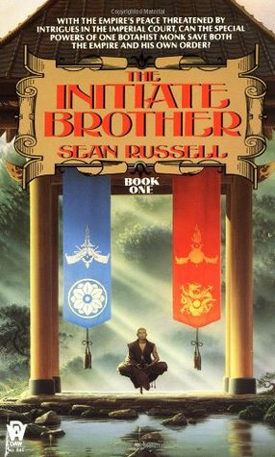 It’s the story of Brother Shuyun, a newly-minted priest of Botahara, assigned as the spiritual advisor to the House of Shonto and its lord, Shonto Motoru. His charges necessarily incude Shonto’s adopted daughter, the Lady Nishima Fanisan Shonto, descended from a family that once held the throne. The Shonto House is not beloved of the Emperor Akantsu, second of his dynasty, which took the throne after a bitter civil war.
And there are the barbarians in the North, who continue to raid the northern province of Seh, but something is different this time. Akantsu appoints Shonto Motoru as Imperial Governor of the province with the charge of ending the barbarian incursions. Only an innocent would believe that Akantsu intends for Motoru to survive the experience.
Where to start? The setting is akin to ancient China, with an overlay of the society of Imperial Japan — while the geography calls to mind China in perhaps the tenth to twelfth centuries (although I’m reluctant to assign a period — that would be pointless, if it’s even possible), complete with the threat of barbarian invasion from the North, the social forms are very much reminiscent of the formality and codes of conduct of the Imperial Court of Japan.
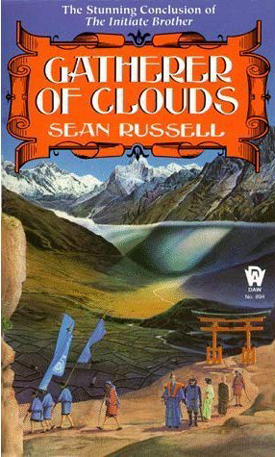 As I noted, it’s a story vast in scope, from the northern wastes to the capital in the South, but the focus is intimate: Russell focuses on the characters, who are, one and all, richly rendered and who become even more well-defined as the story progresses. Oddly enough, even though the story is really Shuyun’s — whose name comes from the language of the mountain people and means “Bearer”, and whose previous incarnations are a mystery to the monks of the Botahist Brotherhood — for much of it he is in the background as the focus shifts from Shonto Motoru to Lady Nishima to Jaku Katta, commander of the Imperial Guard and one who is out for hmself first and foremost, to the Emperor, who is faintly stupid and more than a little paranoid. However, the story does start with Shuyun, and ends with him, as two mysteries are resolved: Where are the scrolls containing the writings of Botahara, which have been closely guarded by the Brotherhood but have been missing for a number of years; and what happened to Brother Satake, the former Spiritual Advisor to House Shonto, who is one of a number of monks who have simply vanished? (And to be quite honest, if these resolutions come as a surprise, you haven’t been paying attention. They’re still very satisfying, though.)
I should mention Russell’s prose. This is not, by and large, a fast-paced story: it has the studied pace of a tea ceremony, although there are enough battle scenes to keep an action-adventure fan engaged. It’s a story of character and situation, and Russell manages to make it totally absorbing: it’s like being adrift on a river, just going with the flow, and enjoying the small rewards as they appear. And it’s all completely transparent: Russell is not showing off, he’s just an amazing writer. (Do keep in mind that this is a story I’ve read several times, and it still sucks me right in.)
If you’re looking for some engaging summer reading, or something to while away those long winter evenings, this is a strong candidate.
(DAW Books, 1991, 1992)
