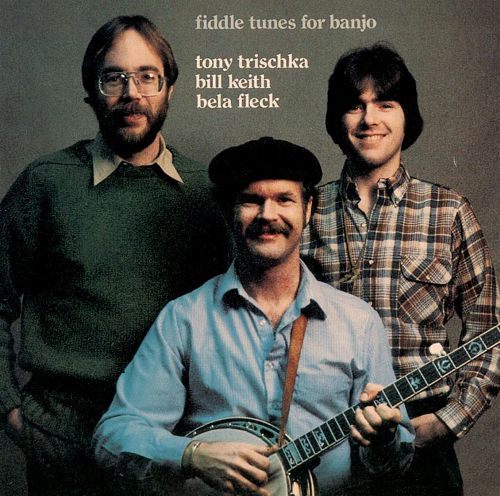
 The MusicHound Country Essential Album Guide (Visible Ink, 1997), under its entry on Tony Trischka, lists Fiddle Tunes for Banjo as “worth searching for. Thanks to the good folks at Rounder, you no longer have to search for a rare old vinyl copy, because it’s now available on CD, digitally remastered from the original analog tapes. Since people have been writing music for one instrument, others have been figuring out how to play it on other instruments. It may just be an illustration of the perversity of musicians. But if it’s done right, the result can be sublime: think about some of Bach’s piano pieces transcribed for guitar.
Earlier this century, Doc Watson moved into the spotlight of the folk revival with his note-for-note guitar renditions of old fiddle tunes. In this album, we see three modern banjo masters appropriating fiddle tunes for their instruments.
This has been going on as long as people have been playing fiddle and banjo together, back in the hills and wherever else players congregate. The significance of this album is that we hear three excellent banjo players beginning to add some jazz influences to these traditional and bluegrass tunes. It’s an idea that Fleck and the Flecktones in the Nineties have pushed far beyond these humble beginnings.
We also hear these three players having a lot of fun.
Now, I have to confess that listening to a whole record’s worth of banjo usually leaves me feeling like a chihuahua on an espresso jag. But that’s generally because of two factors: speed and tone. Some banjo pickers just can’t stop themselves from playing as fast as is humanly possible, and then some. And they also seem to share the attitude of heavy-metal guitar players that there’s no money below the tenth fret. So not only do they play inhumanly fast, they also play up there where only dogs can hear about half the notes they’re playing.
Trischka, Keith and Fleck, thankfully, show admirable taste and restraint on this disc, and only very occasionally leave me with jangled banjo nerves. They are (as the Folk Tales music editor Brendan Foreman once wrote about Doc Watson), musicians concerned with art and beauty rather than pyrotechnics.
Keith in the Sixties pioneered the techniques used to play traditional fiddle tunes on the banjo. Trischka was among the first to play jazz on the five-string banjo, and coincidentally was Fleck’s first banjo teacher.
Most of this album’s tracks feature one of the three players performing separately with their own backing musicians. It opens, however, with the three playing an excellent version of the traditional “Bill Cheatham.” The trio alternates tight unison playing with individual solos (or “breaks” as they’re known in this kind of music). The unison sections remind me of those Scandinavian fiddle orchestras that feature a dozen or more violins, all playing a melody together. I think maybe banjo players are extremely territorial or something, because you hardly ever hear them playing more than one at a time. So this is an unusual sound, and a welcome change.
At times on this piece, you can hear them fighting successfully to keep the tempo in check, especially during Trischka’s break.
The CD includes two bonus tracks of the trio playing together, the traditional “John Hardy” right in the middle, and Bill Monroe’s “Salt Creek” tacked on the end. Both were recorded at Fleck’s New York apartment and have a tentative, “demo” sound to them. The jazzy treatment of “John Hardy” is the more interesting of the two pieces.
The best track is Trischka’s improvised “Vanished,” featuring stunning interplay between the banjoist and fiddler Darol Anger. The piece fluidly combines blues, jazz and Celtic strains. Both players seem utterly relaxed, with absolutely no tendency to rush the tempo, and yet the piece fairly pulses with dramatic tension. This is one for the headphones or a very good set of speakers, so you don’t miss any of the nuances.
The rest of Trischka’s contributions are quite good as well. He is backed by a stellar band, including Kenny Kosek and Matt Glaser on fiddles, Russ Barenberg on guitar, Roger Mason on bass and the great Andy Statman on mandolin. Statman makes every piece he plays on just a little extra special, with his understated yet amazingly proficient picking. (A big thanks to fellow Folk Tales staffer Dan Herman for introducing me to Statman’s music.)
Trischka’s “Dust on the Needle” is another excellent piece, especially the exciting final “tutti” run-through of the melody when everybody plays in unison. The trad “Paddy Kelly’s Jig” tacked on the end, with Jay Ungar on fiddle and mandolin, suffers by comparison with “Dust.”
Trischka and ensemble also turn in a jazzy version of the trad “Black Mountain Rag,” featuring a way-out Statman break. But once you’ve heard Doc Watson and Vassar Clements play this piece (on the Nitty Gritty Dirt Band’s classic Will the Circle Be Unbroken), anything else falls a little short. Dede Wyland’s scatted vocals toward the end also are superfluous and give the piece a dated Seventies sound.
Bill Keith’s contributions lean more toward the traditional. His playing on most of them, especially “Clinging Vine,” has a warm tone that avoids the instrument’s tendency toward clattery, rattley sound. Kosek and Larry Campbell do some nice fiddle work with Keith, as does Barenberg on guitar.
Keith’s “Mead Mountain Blues” is well positioned, just before Trischka’s “Vanished.” It’s got a very bluesy, funky sound to it, with some hot bass work by Lincoln Schleifer. Some of the fiddle work on this tune strays perilously close to screechy territory, however.
Keith’s arrangement of Bill Monroe’s “Panhandle Country,” the final track on the original vinyl album, downplays the banjo’s part. The tune is played at a very brisk, Monroe-esque tempo, and Kosek’s and Glaser’s twin fiddles give the tune an appropriate Texas swing flavor. The electric bass is a little obtrusively forward in the mix, however.
On several of Fleck’s pieces, especially the trad “Fiddler’s Dream” and his own “Barbara’s Waltz,” Bela’s flatpicked guitar work is a real treat. Sam Bush also turns in some buoyant, warm fiddling, especially on “Salty,” a jazzy tune which showcases the fiddle and Jimmy Gaudreau’s mandolin.
“Barbara’s Waltz” is a lovely, melodic piece, featuring double-tracking by Bush on the fiddle, and Fleck wisely following Keith’s lead and keeping the banjo down in its lower, warmer range.
Fleck gives his sidemen lots of room, putting Bush’s fiddle and Gaudreau’s mandolin in front of the banjo on “Salty.” When Bela does come in with a break, it’s clever without being too showy.
Fleck demonstrates a solid feel for traditional forms with his own composition, “Christina’s Jig/Plain Brown Jig,” which features some jazzy breaks that at times have a Gypsy flavor to them.
All in all, this is an enjoyable CD. It’s an interesting historical piece, showcasing the beginnings of Fleck’s popular jazz/bluegrass fusion, and it has some worthwhile music in its own right. Trischka’s “Vanished” is almost worth the price of the CD itself. If you like banjos played with a sense of style and restraint, you’ll like this one.
(Rounder 1981, CD reissued 1999)
