 Chris Woods penned this review.
I first heard John Fahey’s music way back in the ’60’s. His early music albums were not generally available here in the UK then, I think there was just one which came out on Vanguard, but I was lucky enough to meet someone who was already a dedicated fan. So dedicated, in fact, that he sent to America for copies of all the early albums, this in the days before cheap transatlantic phone calls or easy to use international credit cards. I think we even had restrictions on spending money abroad to ‘protect the pound,’ just to add another obstacle. So when I say dedicated, I mean dedicated. I haven’t seen or heard of my university classmate for 30 years now and I wonder if he is still a fan, and if he will be reading this book.
I can’t pretend to have been quite so dedicated myself, but I certainly enjoyed the late night sessions listening to the albums with their eccentric and rather strange liner notes, odd quirky titles and sometimes fantastical explanations of the tunes. From that time on, whenever I saw a John Fahey album in a rack and had some money in my pocket, I bought it, and I have been listening to these albums for 30 years. I still don’t understand the booklet To The Transfiguration of Blind Joe Death, but that’s probably not too important. Hasn’t destroyed my life, anyhow.
The appeal of John Fahey’s music is hard to define. It’s not just the ragtime blues element. Although that’s a big factor and John Fahey is a master of the style, lots of people play good ragtime guitar. Fahey’s playing is simply unlike anyone else’s. He makes it sound so easy and uncomplicated and direct, almost childish in its naivety and simplicity, but there is always a subtle twist. Maybe an unusual tuning, maybe the uncanny sense of timing that provides such a haunting and ethereal atmosphere, maybe it’s just the gentle eccentricities of the player, and the guitar is just a vehicle that transmits them. Whatever it is, while there may be imitators there is no-one quite like the original!
Now you may be wondering why I’m rambling on about the ’60’s and about Fahey’s music in what is supposed to be a book review.
Well, first of all this book is one of stories and reminiscences, some as long ago as the ’50’s, some set around the time I was discovering the music, some later. Although I’m sadly lacking the skill and panache of the book, I thought I would at least try and get you into a retrospective mood.
Secondly, I’m guessing that most of you will have heard the music, and now I can say that I find the book has many of exactly those same features as I hear in the music. Just as the guitar tunes have an apparent simplicity, so do the stories in this book, but just as the tunes are never as simple as they seem, neither are these stories. This book is classic John Fahey; only the instrument has changed.
They all start out as seemingly gentle, unsophisticated, uncomplicated stories, written in an apparently straightforward style. You are lulled into a sense of security with what appear to be entertaining but mundane autobiographical reminiscences, but then you begin to perceive the twists of perception and the off-centre viewpoint. Without realising it you are effortlessly drawn into a world which is similar to, but significantly different from, the one you thought you knew. Or maybe it’s the same world and you are not seeing it right.
The book contains 12 stories, one over 50 pages, some very short, more like vignettes. The first is about growing up in the neighbourhood and hanging out with the local gang, a tale which continues into the second story in the book. Simple subject, simple theme, but as soon as you let down your guard you find you are reading a discussion of religion or a diatribe against paedophiles or an analysis of the psychology of leadership. Without losing the plot or even interrupting the story, elements are drawn in which open the story into the realms of philosophical discussion and subtle fantasy.
This is true of all the stories: The third story, oddly called ‘two,’ is apparently about a crazy guy in the neighbourhood and his obsession. ‘Communism,’ the fourth story, is not about communism at all but is about exclusion and the establishment conspiracy (amongst other things) wrapped inside a short story of a growing child. ‘Henry Vestine and the Allure of La Plastique’ is about Henry Vestine of Canned Heat — well, that is the ‘peg’ on which this short story hangs — but the subject is an expose of middle-class hypocrisy. ‘April in the Orange’ is one of my favourites from the book, basically boy meets girl, love at first sight, but of course it’s not that simple. Does the girl have supernatural powers or are love and people more powerful than we think? As with so many aspects of the book, it’s left to the reader to decide.
I would love to know just how autobiographically accurate this book is. It is certainly written as though these are real reminiscences. The locations, like his growing up around Maryland; the fascination with turtles (which we find also on his music albums); and the mention of other real people, friends, musicians and artists; festivals; music business connections, and situations all appear autobiographical. Yet the book is categorised as fiction. The real world doesn’t contain residents like the cat people who dance in the street, and I seriously doubt there is a real ‘Blood Guilt Avenue’ in Maryland. Are these fantasy or are they symbolic, reality seen from a different perspective? My guess would be, and this is only a personal guess, I have no inside information, that many of the settings, people and incidents are based on fact but somewhere along the line imagination and fantasy take over. We will probably never know where the division between fact and fiction is, how much is true, how much is wishful thinking and how much is fantasy.
On the other hand, if what you want from the book is to learn more about John Fahey, then it’s unimportant what is literal truth and what is fiction; there is plenty here about the artist. There are themes and feelings which recur throughout the book, which to my mind are more revealing about John Fahey as a person than simply knowing autobiographical details would be.
The book is full of opinions and feelings, discourses and examples covering subjects the author feels are important. Hypocrisy, whether in religion or the music business, recurs as a target for Fahey’s witty, wryly humorous but sometimes acerbic comments. There is a strong affection for those people who do right by others and a sharp outspokenness against unfairness, control, and people who dominate others. The feeling throughout the book is strongly compassionate and understanding of the human condition, with a considerable depth of understanding of people, their motives and their behaviour. To have wrapped this philosophical level of meaning into the gentle stories contained in the book tells us much about the artist, and cannot but increase our respect for Fahey’s perception and imagination.
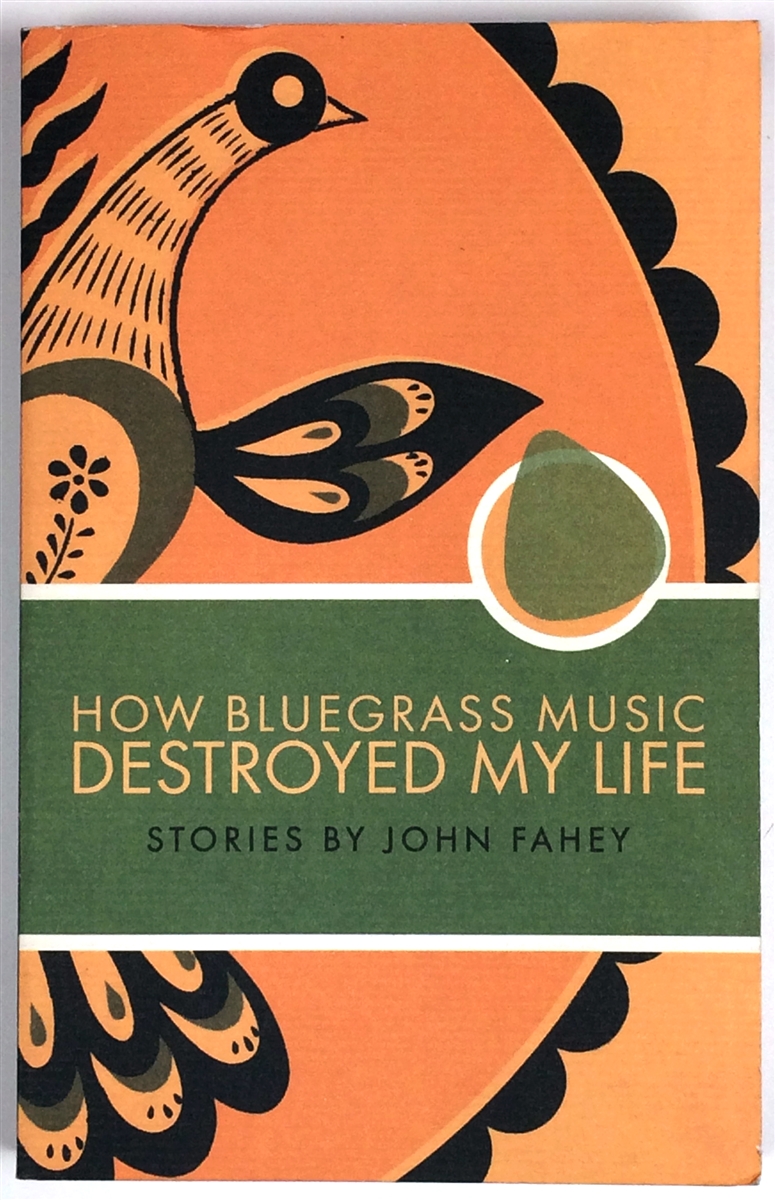
I thoroughly enjoyed reading this book. In a few days’ time I shall read it again, and probably again after that. I’m sure there are a whole load of ideas in there which I missed or didn’t fully understand first time around. There is probably some stuff I may never understand, but that’s OK by me; I don’t think we are intended to understand everything. It’s an unusual book in many ways, strange, outspoken, full of hidden depth and emotion yet at the same time charmingly simple and direct. It looks a bit expensive at almost $20 for a small book, but the print is small, the paper is thin, and like the stories there is a lot more in there than you expect to find.
So, how did bluegrass music destroy Fahey’s life? Well, to be honest, I’m not really sure; you need to read it for yourself and maybe you can work it out.
(Drag City, 2000)
